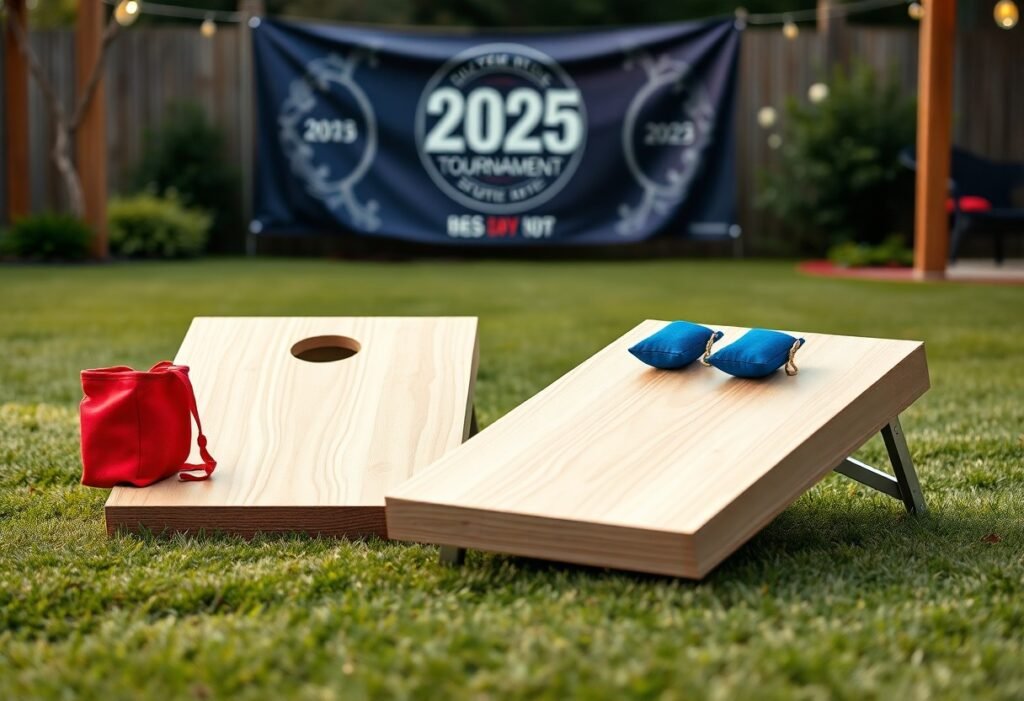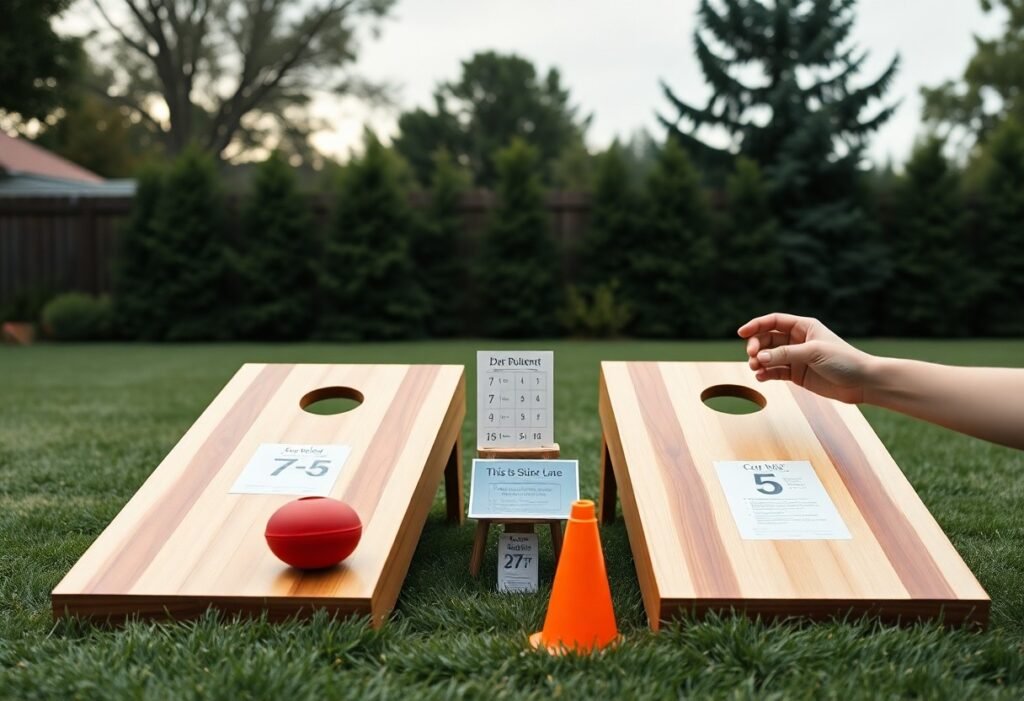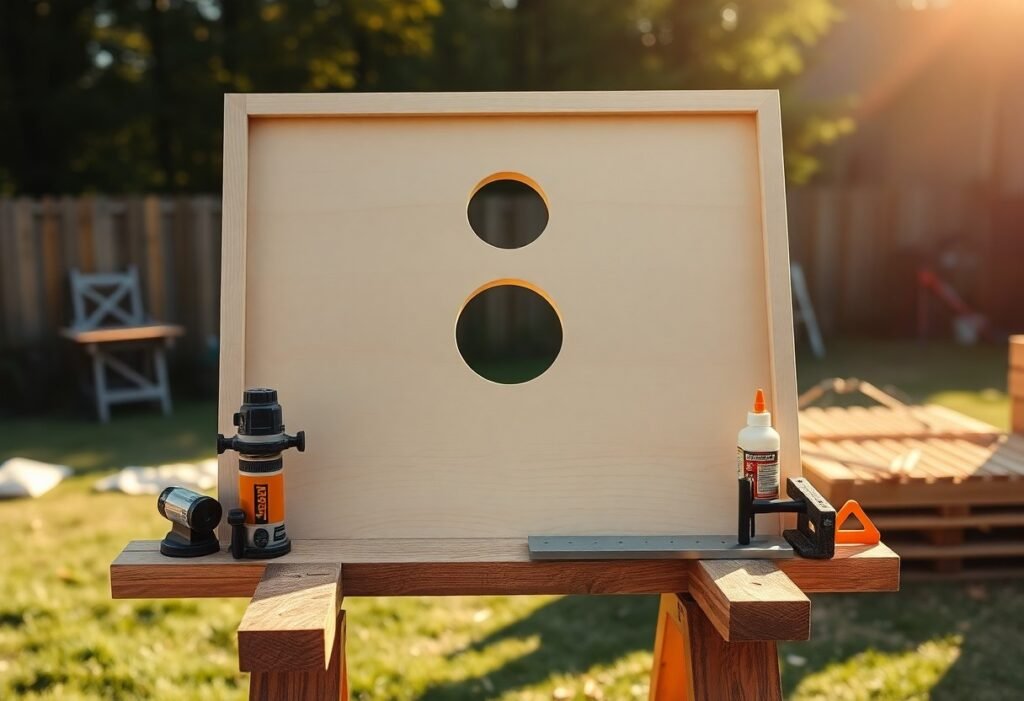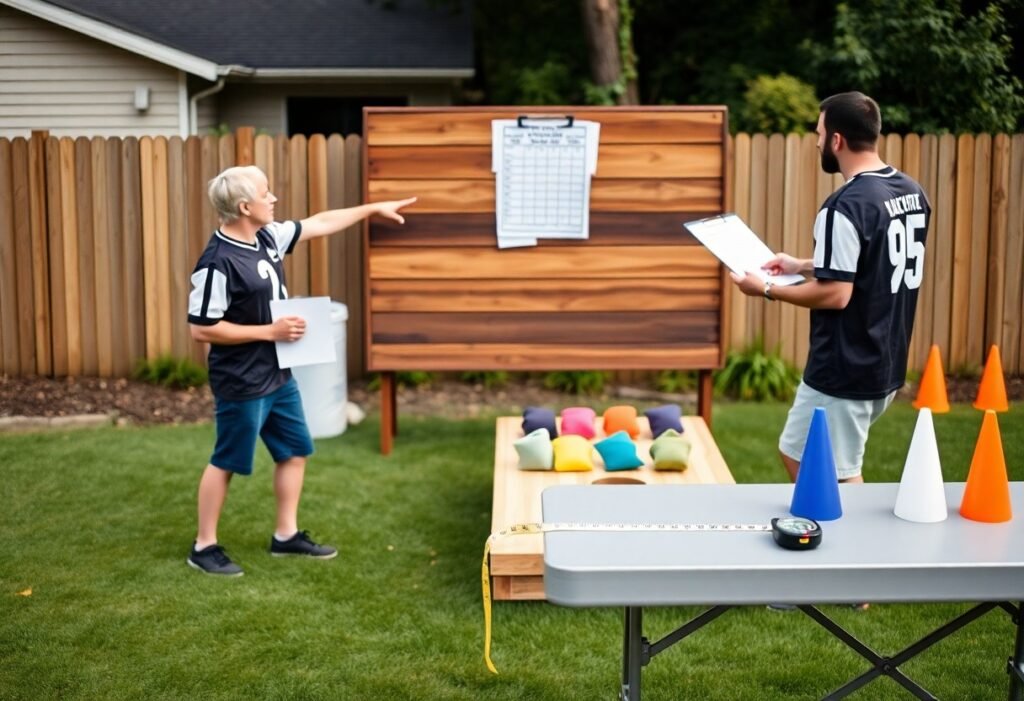

It’s crucial that you learn the official format: cancellation scoring with play to 21 points, where only net points count each inning; you must also follow pitching rotation and positioning so you do not cross the foul line (a rules violation that can cost you points or innings); overall, cornhole is easy to learn and great for players of all ages, but mastering strategy and consistency will make your game competitive.
Key Takeaways:
- Scoring: 3 points for a bag in the hole, 1 point for a bag on the board; cancellation scoring applies – subtract the lower inning total from the higher to get that inning’s score.
- Gameplay: Teams alternate throws, each player throws four bags per inning from the pitcher’s box; an inning ends after all eight bags are thrown.
- Winning and fouls: Games are played to 21 points with the winning score determined at the end of an inning; fouls (foot faults, throwing out of turn, or bags landing off-board) score zero for that bag.

Overview of Cornhole
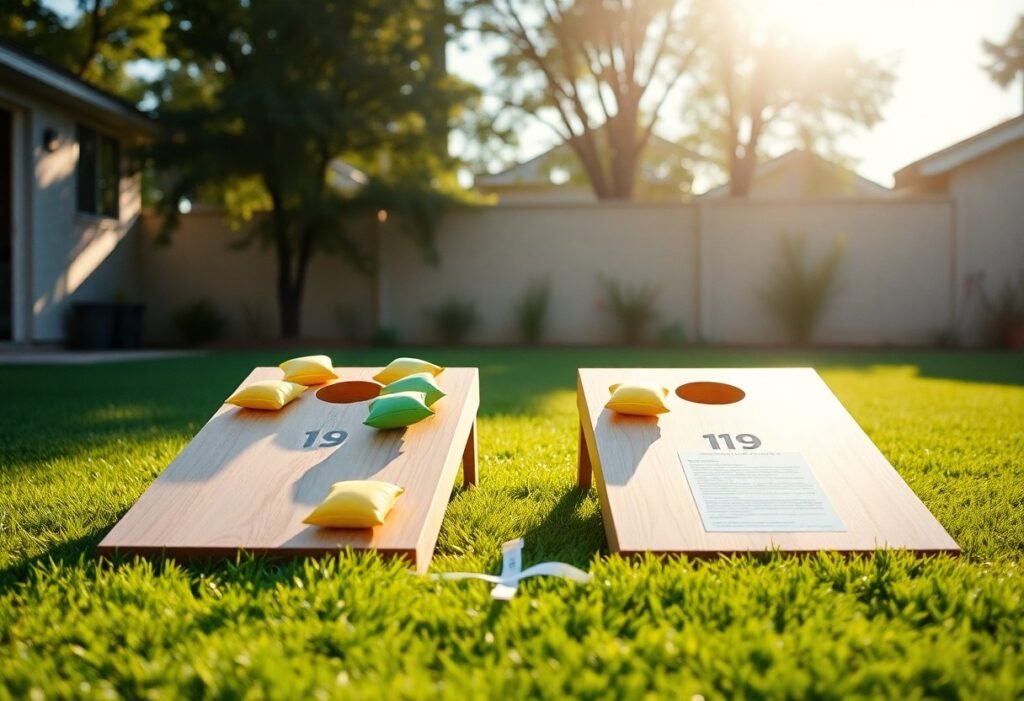
You’ll notice regulation play uses a pair of 2-by-4-foot boards with a 6-inch hole, set with the front edges 27 feet apart in standard competition. Scoring stays simple: a bag in the hole is worth 3 points, on the board is 1 point, and cancellation scoring decides the inning result. You should expect matches to emphasize consistency, lane angles and bag placement more than raw power, especially in league play where small margins swing outcomes quickly.
History of Cornhole
Modern cornhole has roots in rural tossing games. These games were played in the American Midwest and Appalachia. During the 20th century, it evolved from a backyard pastime into an organized sport. Regional tournaments and standardized boards led to formal rules in the 2000s. Leagues and major events now draw hundreds of teams. They compete in regional qualifiers and national championships. This has turned a folk game into a popular competitive format.
Popularity and Play Styles
You’ll find cornhole played everywhere from tailgates and bars to sanctioned arenas, with formats for singles, doubles and mixed doubles. Backyard matches often shorten the distance to 21-24 feet, while league and pro events stick to 27 feet. Styles range from gentle slide shots that use board physics to aggressive airmails aiming for direct holes; each approach changes scoring probabilities and defensive counters.
You should learn common shot types. These include the low, controlled push slide and the angled cut block. Another key shot is the high-risk airmail, thrown directly into the hole. Also master the block-to-score strategy.
In practice, mix a reliable 1-point board game with occasional 3-point airmails. This forces opponents into errors. Conversely, overreliance on power throws increases bounce-outs and misses. This is especially true on slick tournament boards.
Equipment and Setup
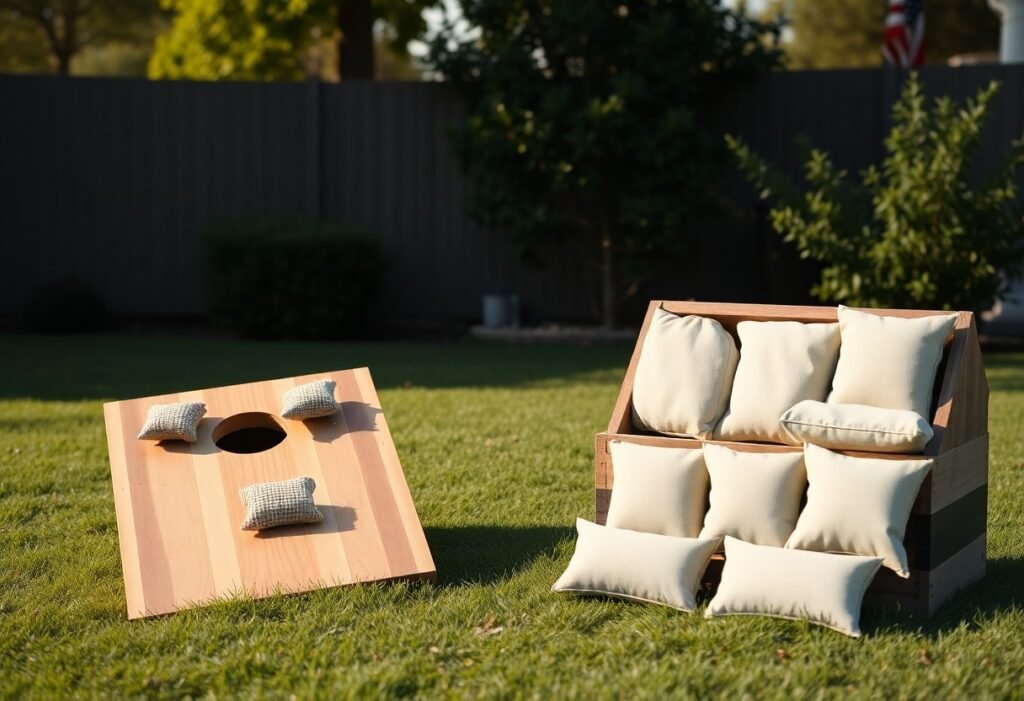
You need regulation boards and bags for fair play. Boards are 24″ x 48″. The 6″ hole is centered 9″ from the top. The front height is 3″ and the back is 12″. Bags are 6″ x 6″, weighing 14-16 oz.
Place boards on a flat, level surface. Use matched bag sets so weight and fabric give no team an advantage.
Bags and Boards Specifications
Tournament bags use canvas or duck cloth. They are filled with resin pellets for consistent weight and weather resistance. Aim for each bag to weigh 14-16 oz. Tighter, reinforced seams are also needed to prevent spills.
Boards are made of solid plywood or polymer. Their surface is finished smooth for a predictable slide. The two 6″ holes must face each other directly. This alignment ensures standardized rebounds and scoring behavior.
Playing Field Arrangement
Place the two boards facing each other. Their front edges should be exactly 27 feet apart for regulation play. Shorter distances, like 21-24 feet, are common for juniors or casual games.
Align the centers so the holes are on the same axis. Keep the playing area level. Also, clear at least a few feet around each board. This prevents tripping or interference.
Measure distances from the front edge of each board-this line functions as the foul line you must not cross when pitching. Alternate throws from the same side between teammates, and remove any bag that lands after a foot foul. For competition you should mark the front edges and centerline clearly so officials and players can enforce consistent positioning and scoring.
Basic Rules of Play
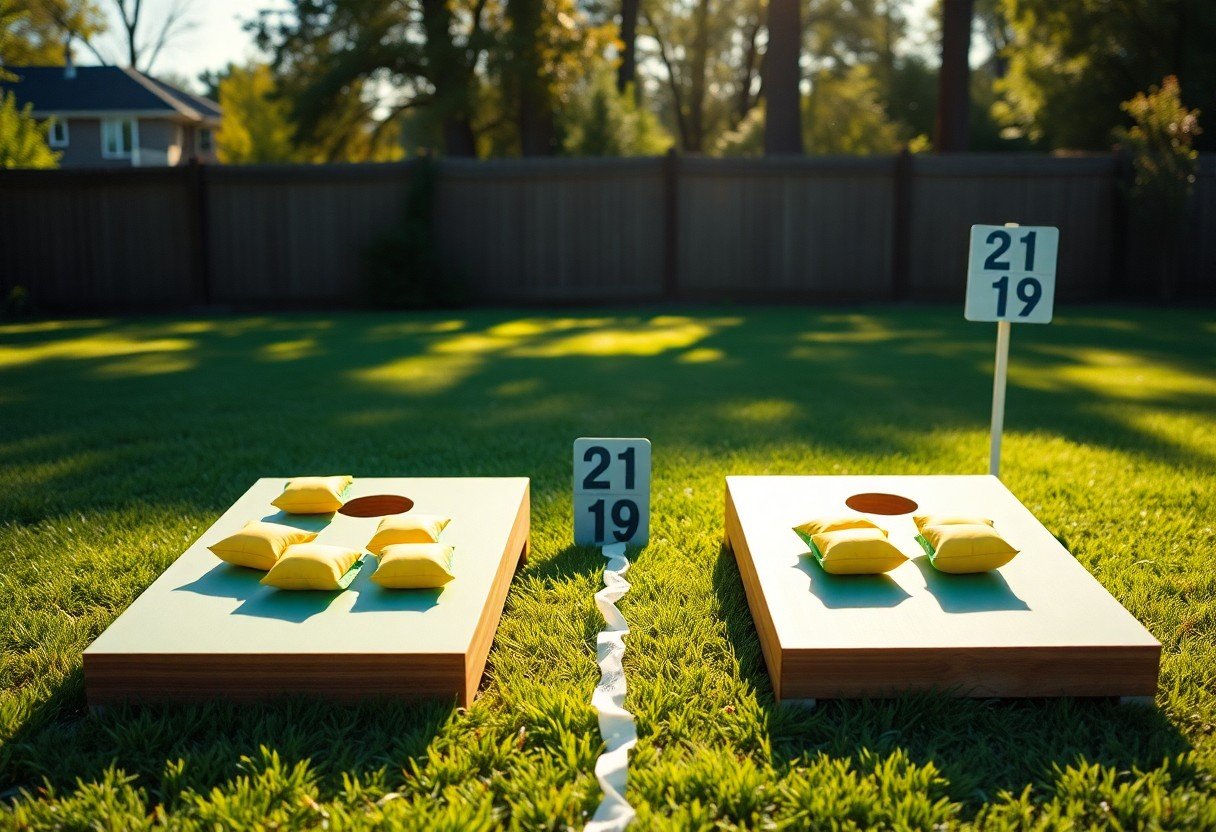
Players take alternating throws to reach 21 points. Regulation scoring awards 3 points for a bag in the hole. A bag on the board scores 1 point. Cancellation scoring is applied each inning.
You and your opponent stand at opposite boards. Throw in turn until all eight bags are thrown. Then, total the inning and apply cancellations. Play continues inning by inning. The game ends when one side reaches or exceeds 21 points.
Player Turns and Scoring Methods
You and your teammate alternate throws with your opponents. In standard doubles, this results in four bags per team per inning. There are eight throws total.
After all throws, tally each team’s raw points. For example, two bags in the hole (6 points) plus one on the board (1 point) equals 7. Then, apply cancellation scoring. You subtract the lower team total from the higher total. The inning winner receives this difference, which counts toward reaching 21 points.
Foul Lines and Ground Rules
You must release your bag while entirely behind the board’s front edge, or foul line. If your foot crosses the front edge before release, it is a foul. That bag is removed and does not score.
Additionally, any bag that touches the ground before landing is dead. It is removed from play, even if it later slides onto the scoring surface.
You may stand to either side of the board. You cannot step or lean over the front edge during release. Doing so voids that throw.
If a bag contacts the ground, it is removed immediately. For example, a bag that hits dirt and then bounces onto the board scores zero.
In case of interference, follow tournament or house rules. Interference includes wind, a displaced board, or spectator contact. Typically, a judge will call a rethrow or remove the affected bags. This depends on the situation.

Scoring System
You tally points each inning with 3 points for a bag in the hole and 1 point for a bag on the board; foul bags score 0. Teams throw four bags each per inning, so a single team can score up to 12 points in an inning. Cancellation scoring applies immediately: opposing totals are subtracted and only the net difference counts toward your match score, which is why precise counting every inning matters.
Points Awarded for Bags
When you land a bag, classify it: in-the-hole = 3 points, on-the-board = 1 point, off-board or foul = 0. Since each side throws four bags, examples matter: two in-the-hole and one board equals 7 points for your inning. Tournament rules uniformly cap a single-team inning at 12 points, so bag placement precision yields the biggest scoring gains.
Cancellation Scoring Explained
In cancellation scoring you subtract your opponent’s inning total from yours; if you scored 7 and they scored 5, you earn 2 points that inning. Ties produce zero points for both teams that inning, and any foul bags still score 0 and can effectively cancel potential gains. This method keeps scores volatile and strategic.
For clarity: if you sink 2 hole bags (6) plus 1 board (1) = 7, and your opponent sinks 1 hole (3) plus 2 boards (2) = 5, your team gains 2 points. Conversely, if the opponent outscores you 9-7, they take 2 points. Because each team can score up to 12 points per inning, a single high-scoring inning can turn a match, and even one opponent bag can neutralize your entire inning.
Tournament Regulations
Tournaments enforce strict protocols you must follow: check-in times, equipment inspection, and bracket seeding are enforced to keep play fair. You’ll see regulation boards (24″×48″) with a 6″ hole 9″ from the top and approved bag sets checked before play. Event schedules and pairings are often posted – for example, view the slot for Cornhole – Game 1 – and failure to appear can result in immediate forfeit.
Official Rules by ACO
ACO rules define scoring, equipment, and conduct. They also set dispute procedures. The rules mandate cancellation scoring. Regular matches are standardized to 21 points.
You must adhere to bag and board measurements. Pitching order and foul definitions are also specified. Tournament directors use this rulebook for protests and match adjudication.
Match Formats and Time Limits
Formats vary: singles, doubles and coed divisions are common, with matches typically run as best-of-three to 21 or single-game eliminations in early rounds. You’ll often encounter timed elements-shot clocks and match caps-to keep events on schedule, and organizers announce specific limits on check-in sheets and scoreboards.
Regional events often use pool play. This typically involves 4-team pools. The top two teams from each pool advance to a double-elimination bracket.
Matches in pool play are often best-of-three to 21 points. Later rounds may remain best-of-three or switch to a single deciding set.
Expect a 20-30 second shot clock per throw at higher levels. Matches may have a 25-45 minute time cap in busy schedules. Teams usually get one or two short timeouts, depending on tournament policy.
Common Rule Variations
House Rules and Custom Games
You’ll encounter dozens of backyard tweaks: many groups play to 11 or 15 points instead of 21 for faster rounds, some remove cancellation scoring so every bag counts, and others add party twists like double-point “bonus holes” or a skunk rule (win if you lead by 11). Hosts often shift the foul line or let runners count after contact with the ground. If you join a new group, confirm scoring, target score, and any special bag or tossing restrictions before you start.
Regional Variations in Play
In competitive circuits you’ll see rigid standards, while local scenes split: the standard board spacing is 27 feet, but many regions shorten to 21-24 feet for casual play or juniors. Tournaments run by ACL/ACO push strict board, bag and cancellation-scoring rules, whereas tailgates favor quick games, non-cancellation scoring, or house-specific “gator” formats that reward long runs.
Digging deeper, you’ll find state- and city-level traditions: Midwestern leagues commonly use cancellation scoring and 21-point matches, coastal party scenes prefer 11-point sprints, and college tournaments often mandate verified bag specs and strict foul enforcement. Because equipment and distance changes affect shot selection and safety, check the host or league rules – they determine whether you should practice short push shots or long lofting tosses before play.
Summing up
Ultimately, mastering the official cornhole rules and scoring system enables you to play and officiate with confidence; you will apply cancellation scoring correctly, enforce foul and board rules, and score consistently so matches remain fair and competitive, making your decisions prompt and authoritative.
FAQ
Q: What are regulation cornhole board and court dimensions?
A: Regulation boards are 48 inches long by 24 inches wide with a 6-inch diameter hole centered 9 inches from the top edge. The front of the board is approximately 3-4 inches high and the back is about 12 inches high. Regulation distance between the front edges of the two boards (front-to-front) is 27 feet for adult play; many youth and casual games use shorter distances. Each player or team uses four bags; standard bag size and weight are roughly 6×6 inches and 15-16 ounces, but leagues may specify exact tolerances.
Q: How is throwing order determined and what are the foul/foot-fault rules?
A: A coin flip or equivalent decides who throws first in the opening inning. In singles the two players throw from the same pitcher’s box; in doubles teammates stand at opposite boards. Players alternate throws so bags are thrown one at a time until all four bags per side have been delivered; the team that scored in the previous inning typically throws first in the next inning, and if no score occurs the same team keeps the initial position. A foul occurs when any part of the player’s foot crosses the front edge of the board (the foul line) at the moment of release; foul bags are removed and do not count. Bags must be thrown by hand from inside the pitcher’s box; league rules determine whether the pivot foot may contact the board, so check local rules for that detail.
Q: How is scoring calculated in cornhole?
A: Scoring uses the cancellation method. A bag that goes through the hole (“cornhole”) is 3 points; a bag that lands and remains on the board is 1 point. After both sides have thrown all their bags in an inning, each team’s points for that inning are totaled and opposing points are subtracted; only the net difference is awarded to the team with the higher inning total. Example: Team A scores two cornholes (2×3=6) and one on-board (1) = 7; Team B scores one cornhole (3) and one on-board (1) = 4; net score = Team A +3 for that inning.
Q: What determines the winner, and are there variations for reaching 21 points?
A: Most competitive play uses cancellation scoring and the winner is the first team to reach or exceed 21 points at the end of an inning. If both teams end an inning tied at or above the target, play continues into extra innings until the tie is broken. Some tournaments and leagues require an exact score of 21 or mandate a minimum winning margin; others may require winning by two points. Always confirm the specific event or league rule for whether “exact 21” or other variants apply.
Q: What are live and dead bags, and how are common disputes handled?
A: A live bag is any bag that lands on the board or goes in the hole without first contacting the ground. A dead bag is any bag that touches the ground before contacting the board or hole; dead bags are removed and do not score. If a live bag knocks another bag into the hole or onto the board without that bag touching the ground, the moved bag remains live and scores accordingly. If a bag is knocked off the board and then contacts the ground, it is dead and does not score. Score disputes are resolved by inspecting where each bag landed and whether it touched the ground prior to contacting the board/hole; scoring is determined only after all bags for the inning have come to rest or been removed as dead.