Have you ever stood at a cornhole board, bag in hand, completely unsure of the rules?
You are not alone. Thousands of new players face this exact moment every summer. They watch others throw, and then they try to copy the motion. Suddenly someone shouts, “That is a foot fault!” Confusion immediately takes over.
The good news is that cornhole is incredibly easy to learn. Most people master the basics in under ten minutes. However, official tournament rules add layers of strategy. Cancellation scoring changes everything. Foul lines can also ruin your best throw.
This guide will change that for you.
You will learn every official rule, understand cancellation scoring completely, and avoid common mistakes that cost points. Most importantly, you will finally feel confident stepping up to any board.
Let us begin your journey to cornhole mastery.
What Is Cornhole? A Complete Overview
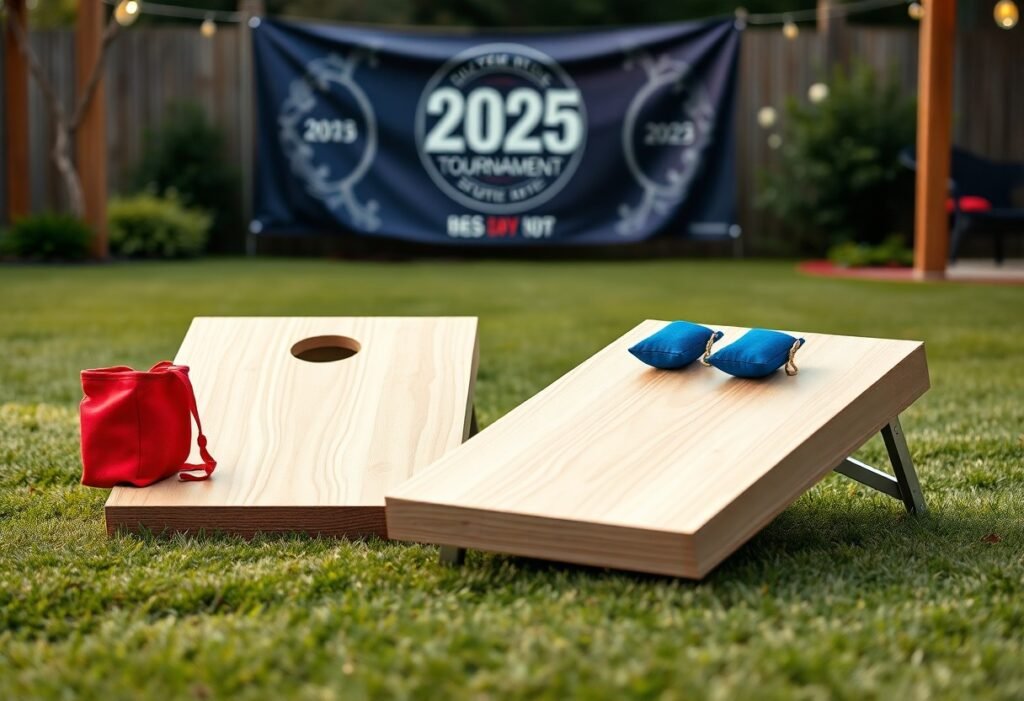
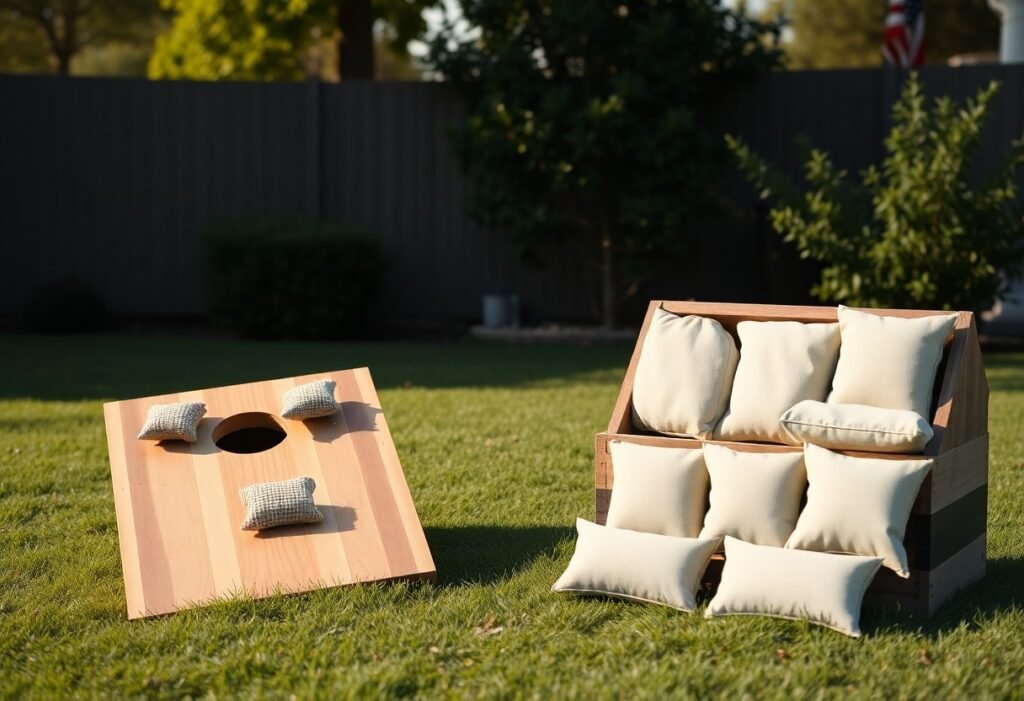
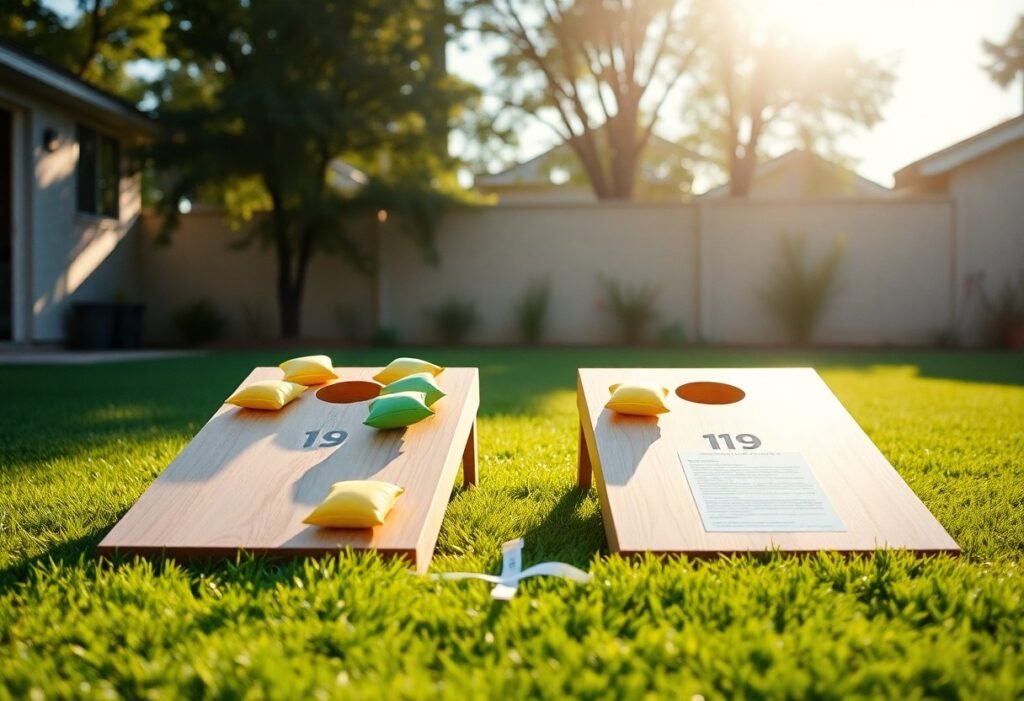
Cornhole is a precision lawn game. Two players or two teams compete against each other. They take turns throwing small fabric bags. The target is an angled wooden board with a single hole.
The name “cornhole” has an interesting history. Early versions used bags filled with dried corn. Modern regulation bags use resin pellets instead. Nevertheless, the original name stuck.
Why is cornhole so popular today?
Several factors explain its rapid growth.
Firstly, anyone can play the game. Children, grandparents, and athletes all compete equally. Secondly, the equipment is highly portable. Two boards and eight bags fit in any car. Thirdly, the rules are straightforward. You will understand them after just one game. Finally, the social aspect keeps people coming back.
The American Cornhole Organization (ACO) reports over 50,000 active tournament players. That number grows each year. Major events now offer prize pools exceeding $100,000.
“Cornhole is the fastest-growing sport in America. Our tournaments sell out months in advance.” — Frank Geers, Founder of the American Cornhole Organization
Chapter 1: Official Equipment and Setup
You cannot play proper cornhole without regulation equipment. Let us examine exactly what you need.
Regulation Cornhole Boards
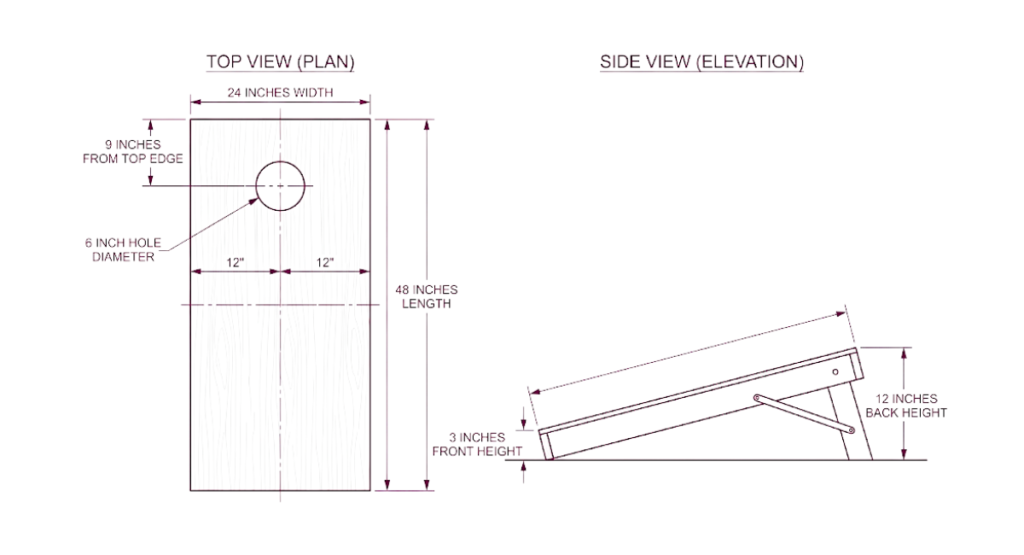
Official boards follow strict measurements. These dimensions ensure fair competition everywhere.
| Specification | Regulation Measurement | Why It Matters |
|---|---|---|
| Length | 48 inches (4 feet) | Standard throwing distance reference |
| Width | 24 inches (2 feet) | Consistent landing surface |
| Hole diameter | 6 inches | Challenging but achievable target |
| Hole center from top edge | 9 inches | Creates proper bag entry angle |
| Front height | 3 to 4 inches | Allows bags to slide up |
| Back height | 12 inches | Prevents bags from flying over |
| Playing surface material | Plywood or polymer | Predictable slide behavior |
The playing surface must be smooth. Tournament boards receive a clear coat finish. This creates consistent bag speed. Some boards use laminate, while others use sealed wood. Both work as long as friction is uniform.
Here is a pro tip: Avoid boards with sticky surfaces. Bags should slide, not grab. Regulation boards allow a bag to travel 6 to 12 inches after landing.
Official Cornhole Bags
Not all bags are created equal. Regulation bags have specific requirements.
Standard bag specifications:
- Size: 6 inches by 6 inches
- Weight: 14 to 16 ounces per bag
- Material: Duck cloth or canvas
- Filling: Resin pellets (never corn or beans)
- Set: Four bags per team, matching colors
- Seams: Double-stitched or reinforced
Why do manufacturers use resin pellets? Corn absorbs moisture, rots over time, and attracts insects. Resin pellets are weather-resistant instead. They maintain consistent weight, and they last for years.
Bag fabric matters too.
Some bags are “slow” (sticky fabric). Others are “fast” (slick fabric). Tournament rules specify acceptable friction levels. Always use matching bag sets. Mixing fast and slow bags creates unfair advantages.
Court Dimensions and Placement
Setting up your court correctly is critical for fair play.
Regulation court requirements:
- Place two boards facing each other
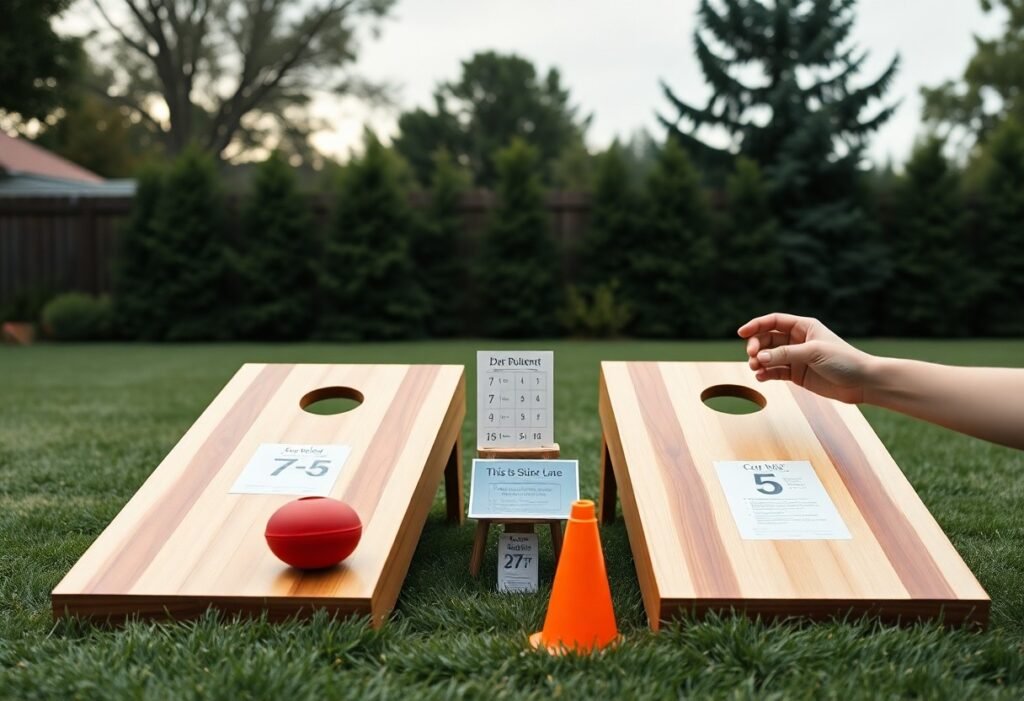
- Front edges must be exactly 27 feet apart (adult regulation)
- Boards must align on the same center axis
- Playing surface must be level
- Clear at least 3 feet of space around each board
- Mark foul lines clearly at each front edge
For casual or junior play:
- Distance may shorten to 21 or 24 feet
- Younger players (under 12) often use 15 feet
- Never change distance mid-match
- Agree on distance before starting
The 27-foot distance creates optimal challenge. Shorter distances increase scoring, whereas longer distances favor skilled players. Tournament play always uses 27 feet.
Chapter 2: How to Play Cornhole – Basic Gameplay
Now that you understand the equipment, let us walk through an actual game.
Players and Team Formats
Cornhole offers two primary playing formats.
Singles (Head-to-Head)
- Two players compete against each other
- Both throw from the same side of the court
- Players alternate throws until all four bags are tossed
- Then both walk to the opposite board
- The next inning begins from the new side
Doubles (Most Common Format)
- Two teams of two players each
- Teammates stand at opposite boards
- One team throws from one end
- The opposing team throws from the opposite end
- Players alternate throws within each inning
- Teammates never throw consecutively
Which format is better for beginners?
Doubles is more forgiving. Your partner can cover your mistakes, whereas singles exposes every weakness. Start with doubles, and then move to singles when your accuracy improves.
Throwing Rotation Rules
The throwing order follows a strict, unchanging pattern.
Opening inning:
- Coin flip determines first thrower
- Winner chooses to throw first or second
- Players alternate throws one bag at a time
- Each player throws four bags per inning
- An inning ends after all eight bags are thrown
Subsequent innings:
- The team that scored in the previous inning throws first
- If no points were scored, the same team retains first throw
- This rule prevents stalling tactics
- It rewards scoring aggression
Common rotation mistake:
Many beginners throw both their bags at once. This is illegal. You must alternate with your opponent instead. Watch for your turn, wait patiently, and then throw.
How to Throw a Cornhole Bag Correctly
Proper technique dramatically improves your accuracy.
Step-by-step throwing guide:
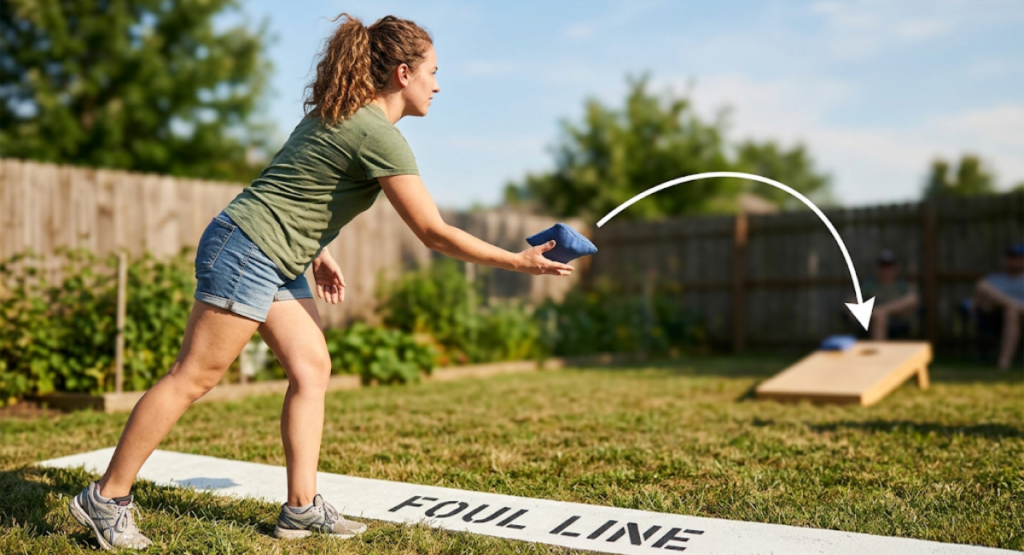
First, stand behind the front edge (foul line).
Place your dominant foot slightly forward.
Then hold the bag with a relaxed, open grip.
Keep your wrist firm but not locked.
Next, use an underhand, pendulum-like motion.
Release the bag at waist height.
After that, aim for a landing spot 6 to 12 inches short of the hole.
Finally, follow through toward your target.
The most common throwing errors:
- Over-rotation: Spinning the bag sideways. This causes erratic bounces.
- High arc: Throwing too high. Wind catches the bag, so accuracy suffers.
- Low line drive: Throwing flat. The bag slides past the hole.
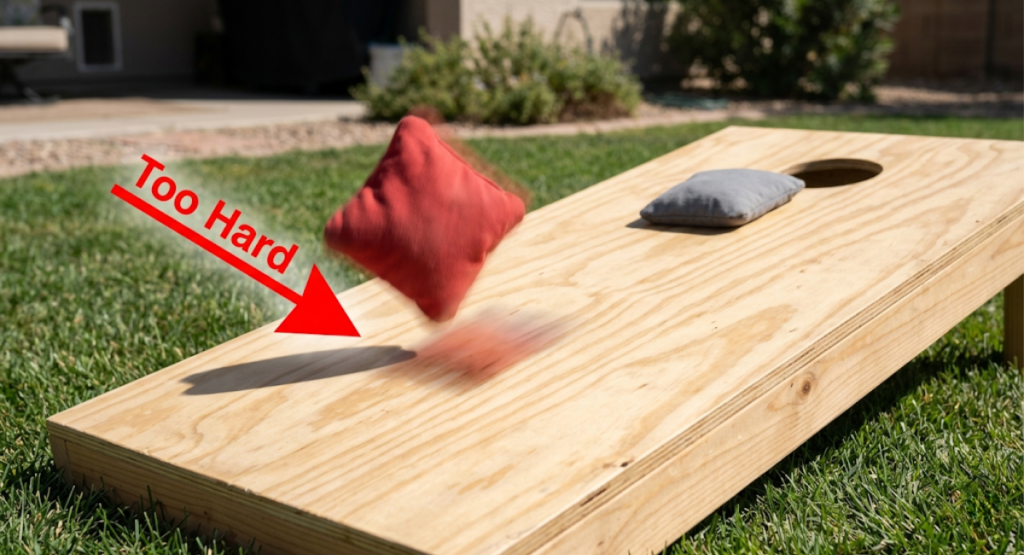
- Hard toss: Throwing with excessive power. Bags bounce off the board.
The ideal throw:
Imagine a smooth, medium arc. The bag reaches its peak about halfway to the board. It descends gently, lands softly, and then slides into the hole.
Practice this motion consistently. Record yourself throwing, and then compare your technique to professional players. Small adjustments will create big improvements.
Chapter 3: Cornhole Scoring System Explained
Scoring confuses most beginners. However, the system is logical once you understand it.
Points Awarded Per Bag
Each bag earns points based exclusively on its final position.
| Bag Position | Points | Key Detail |
|---|---|---|
| Through the hole (cornhole) | 3 points | Must pass completely through |
| On the board surface | 1 point | Must remain on board |
| Leaning on the board edge | 1 point | If bag touches ground, 0 points |
| Hanging over the hole edge | 0 points | Unless it falls through later |
| Off the board | 0 points | Any bag touching ground |
| Foul bag (foot fault) | 0 points | Remove immediately |
| Bag touching ground first | 0 points | Dead on contact |
Here is a critical distinction: A bag hanging over the hole does NOT score 3 points. It must fall completely through. Another bag can knock it through, and then it scores.
Cancellation Scoring (The Most Important Rule)
Here is where cornhole differs from every other lawn game. You do not simply add your points together.
Cancellation scoring changes everything.
How cancellation scoring works:
First, both teams throw all four bags in an inning.
Next, each team calculates their raw points total.
Then subtract the lower total from the higher total.
After that, the difference is the only points awarded that inning.
Finally, the opposing team receives zero points for that inning.
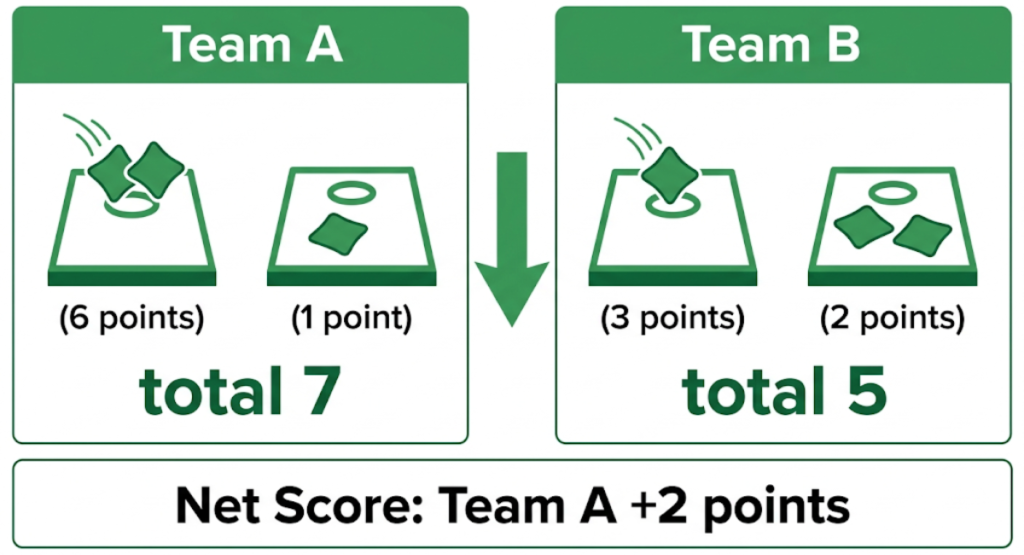
Real-world examples:
Clear winner:
- Team A raw score: Two cornholes (6 points) + one board (1 point) = 7 points
- Team B raw score: One cornhole (3 points) + two boards (2 points) = 5 points
- Net result: Team A gains 2 points (7 minus 5 = 2)
- Team B gains 0 points
Perfect tie:
- Team A raw score: 8 points
- Team B raw score: 8 points
- Net result: Both teams gain 0 points
Opponent wins the inning:
- Team A raw score: 4 points
- Team B raw score: 9 points
- Net result: Team B gains 5 points (9 minus 4 = 5)
Why does cancellation scoring matter?
Firstly, it rewards defense. Blocking opponent bags becomes valuable. Secondly, it prevents runaway scores. One team cannot dominate without resistance. Thirdly, it creates tension throughout the match. Every bag changes the net calculation.
Maximum Points Per Inning
A perfect inning is mathematically possible but extremely rare.
Maximum raw score: 12 points (four cornholes)
Maximum net score after cancellation: 12 points (if opponent scores zero)
Has anyone ever scored 12 net points in a tournament?
Yes, professional players have achieved this feat. However, it requires opponent mistakes. Most tournament innings net between 0 and 4 points.
Chapter 4: Winning the Game – Playing to 21 Points
Understanding how to win is just as important as understanding how to score.
The 21-Point Win Condition
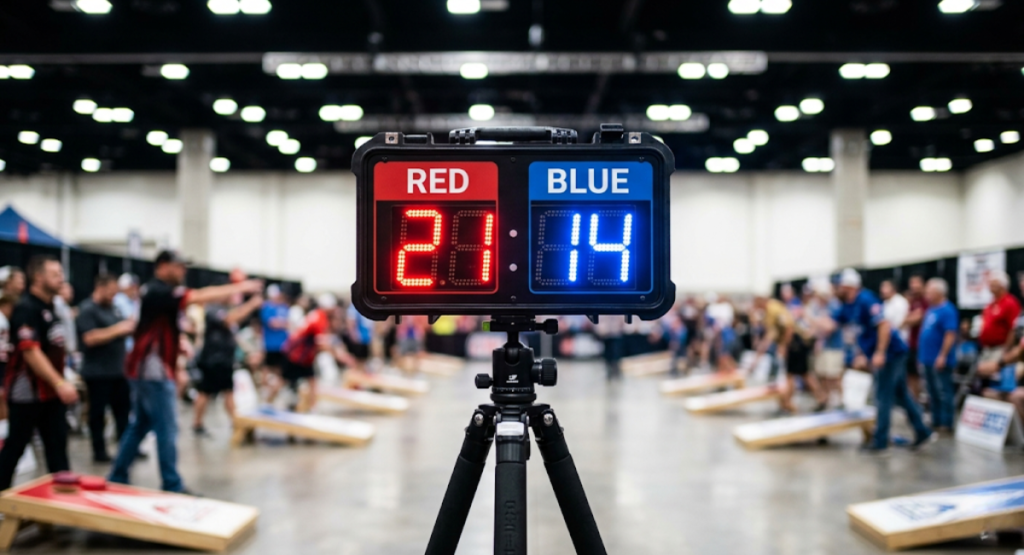
The first team to reach or exceed 21 points at the end of a completed inning wins the game.
Notice the critical phrase: at the end of a completed inning.
You cannot win mid-inning. Both teams must throw all four bags. After the inning ends, scores are tallied. Cancellation scoring applies, and then the winner is determined.
Example scenario:
Your team has 20 points. You throw a bag through the hole, so your raw score becomes 23. However, the inning continues. Your opponent still throws their remaining bags. If they score 4 points, cancellation applies. Your net gain might keep you below 21.
Therefore, always wait for the inning to finish before celebrating.
What Happens in a Tie Game?
Tie games follow specific rules.
Scenario A: Both teams finish an inning with 21 or more points.
- The game continues
- Play extra innings
- Winner is first team to lead after a full inning
In Scenario B, both teams finish with exactly 20 points.
- Normal play continues
- Next inning determines winner
Finally, Scenario C occurs when the tournament time cap is reached.
- Leading team wins
- If tied, sudden-death inning decides winner
Win by 2? Or Just Reach 21?
This confuses many players, so let us clarify.
Official ACO and ACL rules: No win by 2 requirement. Simply reach or exceed 21 at inning’s end.
House rules (casual play): Some groups require win by 2. Others require exactly 21 (no going over). Always confirm before playing.
Tournament play: Always follows official rules. Reach 21 or more. Win by 2 is never required unless specified.
Chapter 5: Fouls, Violations, and Dead Bags
Knowing foul rules protects your score. Avoiding violations keeps you competitive.
The Foot Fault (Most Common Violation)
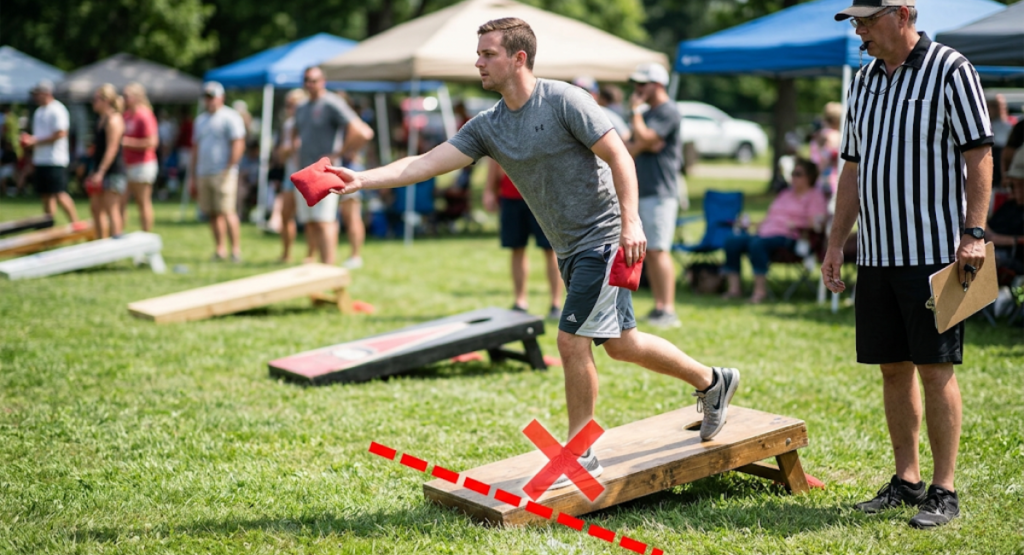
You must release the bag while standing completely behind the front edge.
What constitutes a foot fault:
- Any part of your foot crossing the front edge
- Stepping on or over the foul line
- Leaning forward until your foot lifts and crosses
- Toes extending past the board’s front edge
- Heel touching the line at release
What is NOT a foot fault:
- Touching the side of the board
- Stepping over the line AFTER releasing the bag
- Your back foot crossing (only front foot matters)
Consequence of foot fault: The throw is void. The bag scores zero points. Remove it immediately. No replay is allowed.
Tournament enforcement: Officials watch feet closely. Repeated foot faults can result in warnings. Some tournaments assess penalties for chronic violations.
Dead Bags (Ground Contact)
A bag becomes dead the instant it touches the ground.
Examples of dead bags:
- Bag hits grass then bounces onto the board
- Bag strikes ground and rolls onto playing surface
- Bag hits the board’s side and touches dirt
- Bag hits a spectator then lands on board
- Bag slides off the back and touches ground
Consequence: Remove the bag immediately. Here is the revised version: It scores zero points, does not affect other bags, and cannot knock other bags into scoring positions.
Here is an exception: A bag that never touches ground remains live. Even if it bounces off the board’s back edge, if it never hits ground, it can slide back onto the scoring surface.
Throwing Out of Turn
Players must follow the established rotation strictly.
What happens if you throw out of turn?
- Tournament rule: The throw is voided
- Casual play: Re-do the inning order
- Some leagues: Warning first, then penalty
Prevention tip: Always watch the bag count. Know whose turn is next. Communicate with your partner.
Interference and Disputes
Outside factors sometimes affect play.
Common interference scenarios:
- Wind moves a bag after landing
- Spectator accidentally touches a bag
- Animal runs across the court
- Board is bumped or displaced
Standard resolution:
- If interference affects a throw, replay the throw
- If a bag moves after landing, players agree on original position
- Tournament director has final authority on all disputes
Prevention: Clear the area around boards. Ask spectators to stand back. Remove pets from the playing area.
Chapter 6: Tournament Rules and Match Formats
If you plan to compete, understanding tournament structure is essential.
Common Match Formats
| Format | Players | Common Use |
|---|---|---|
| Singles | 1 vs 1 | Advanced competition |
| Doubles | 2 vs 2 | Most common format |
| Coed | Mixed-gender teams | Social tournaments |
| Pool play | 4 teams per pool | Early tournament rounds |
| Double elimination | Two losses eliminate | Championship brackets |
Match Structure and Scoring
Most tournaments follow this structure:
Pool play rounds:
- Best-of-three matches
- Each game plays to 21 points
- Cancellation scoring applies throughout
- Top two teams from each pool advance
Bracket rounds:
- Best-of-three or single elimination
- Same 21-point game format
- Finals may be best-of-five
Time Limits and Shot Clocks
Higher-level tournaments enforce strict time rules.
Standard time regulations:
- Shot clock: 20 to 30 seconds per throw
- Match time cap: 25 to 45 minutes total
- Timeouts: One or two per team (30 seconds each)
- Between games: 2 to 3 minutes maximum
What happens when time expires?
- If match reaches time cap, leading team wins
- If tied, one sudden-death inning determines winner
- Sudden-death inning uses cancellation scoring
ACO vs. ACL Rule Differences
Two major organizations govern competitive cornhole.
| Organization | Key Rules | Differences |
|---|---|---|
| American Cornhole Organization (ACO) | 27-foot distance, cancellation scoring, 21 points | Strict bag inspection, wooden boards only |
| American Cornhole League (ACL) | Same core rules | Allows polymer boards, different bag approval process |
Which organization is more popular?
Both have strong followings. ACL has more televised events. ACO has deeper historical roots. Most players compete in both.

Chapter 7: Common Mistakes Beginners Make
Learning from others saves you frustration and lost points.
Mistake #1: Throwing With Excessive Power
Power is not your friend in cornhole. Hard throws bounce off the board. They also skip past the hole, and they create unpredictable bounces.
The fix: Use smooth, controlled underhand tosses. Let the bag slide instead of bounce. Aim for a soft landing every time.
Mistake #2: Ignoring Cancellation Scoring
Many beginners celebrate a big inning. Then they realize the opponent also scored, so their net gain is tiny.
The fix: Always track opponent bags. Defensive throws matter as much as offensive ones. Block the hole, and cancel their points whenever possible.
Mistake #3: Stepping Over the Foul Line
Excitement makes you lean forward. Your foot crosses the line, yet your perfect throw scores zero.
The fix: Practice staying behind the line. Tape a physical marker on the ground. Check your foot position before every single throw.
Mistake #4: Not Watching Opponent Throws
You cannot throw effectively if you ignore the board’s current state.
The fix: Watch every opponent throw carefully. See where their bags land. Then adjust your aim based on their bag positions.
Mistake #5: Using Different Bags Each Inning
Switching bags changes weight, feel, and slide behavior. Consequently, consistency disappears.
The fix: Use the same four bags throughout the entire match. Mark your bags if necessary.
Mistake #6: Throwing at the Hole Every Time
Direct hole shots are low percentage. They often miss entirely.
The fix: Aim 6 to 12 inches short of the hole. Let the bag slide into scoring position instead of flying directly at it.
Chapter 8: Myth vs. Fact – Cornhole Edition
Let us clear up common misconceptions once and for all.
| Myth | Fact |
|---|---|
| You must win by 2 points | Official rules only require reaching 21 at inning’s end |
| Bags were originally filled with corn | Early bags used corn, but regulation bags use resin pellets |
| The hole can be any size | Regulation hole is exactly 6 inches in diameter |
| You can throw from anywhere behind the board | You must stay within the pitcher’s box area |
| A hanging bag counts as 3 points | Only counts if it falls completely through |
| Overhand throwing is allowed | Official rules require underhand throws only |
| Boards can be any distance | Regulation distance is 27 feet front edge to front edge |
| You can step on the board | No part of your foot may cross the front edge |
Chapter 9: Pro Strategies to Improve Your Game
Ready to level up? Apply these advanced strategies.
Strategy #1: Block the Hole
Throw bags that slide just short of the hole. These act as physical blockers. Your opponent cannot land a cornhole without knocking your bag through first. If they do knock it through, you still get the 3 points.
Strategy #2: Use the Slide Effectively
Do not throw directly at the hole. Aim 6 to 12 inches short instead. Let the bag slide into the hole naturally. This reduces bounce-outs significantly.
Strategy #3: Read Board Conditions
Morning dew makes boards slow. Afternoon heat makes them fast. Wind requires arc adjustments. Therefore, always adapt your throw to current conditions.
Strategy #4: Practice Cancellation Thinking
Always ask yourself: If my opponent scores, how do I cancel their points? Sometimes a board bag is better than a risky cornhole attempt.
Strategy #5: Master One Throw First
Do not learn every shot type immediately. Master one consistent throw first. Then add variations gradually.
Frequently Asked Questions (FAQ)
Q1: How many points is a cornhole bag worth?
A bag through the hole is worth 3 points. A bag on the board is worth 1 point. Off-board bags score zero. Hanging bags score zero unless they fall through.
Q2: What is cancellation scoring in cornhole?
Cancellation scoring means you subtract your opponent’s inning total from yours. Only the net difference counts toward your match score. This rewards defense and strategy.
Q3: Do you have to win by 2 in cornhole?
No. Official ACO and ACL rules only require reaching or exceeding 21 points at the end of a completed inning. Winning by 2 is a house rule variation only.
Q4: Can you step on the board when throwing?
No. Your foot cannot cross the front edge (foul line). Some casual games allow touching the side, but tournament rules prohibit any foot crossing before release.
Q5: What happens if a bag knocks another bag into the hole?
Both bags score. The bag that was knocked in counts as a 3-point cornhole. The bag that hit it also scores based on its final position.
Q6: How far apart are cornhole boards?
Regulation distance is 27 feet from front edge to front edge for adult play. Juniors and casual games often use 21 or 24 feet.
Q7: Can you throw overhand in cornhole?
No. Official rules require an underhand throw. Overhand throws are illegal in all sanctioned competitions.
Q8: How long does a cornhole game last?
A typical game to 21 points lasts 15 to 25 minutes. Tournament matches with time caps run 25 to 45 minutes maximum.
Q9: What is a dead bag?
A dead bag is any bag that touches the ground before contacting the board or hole. Dead bags are removed immediately and score zero points.
Q10: Who throws first in cornhole?
A coin flip determines the first thrower of the opening inning. After that, the team that scored in the previous inning throws first.

Conclusion: Your Cornhole Journey Starts Now
You now know exactly how to play cornhole by official rules.
You understand the equipment specifications and can explain cancellation scoring confidently. Recognizing fouls and dead bags immediately is also within your grasp. Plus, you have strategies to win more games.
Cornhole rewards consistency over power. It welcomes beginners but challenges experts. It transforms backyard gatherings into friendly competitions.
Therefore, grab a set of regulation bags. Find a friend or three. Set up your boards exactly 27 feet apart. Take a breath, and then throw.
Your first official cornhole is closer than you think.
Ready to play? Share this guide with your cornhole partners. Bookmark it for tournament preparation. Practice the pro strategies above. Finally, always remember: only net points count.