
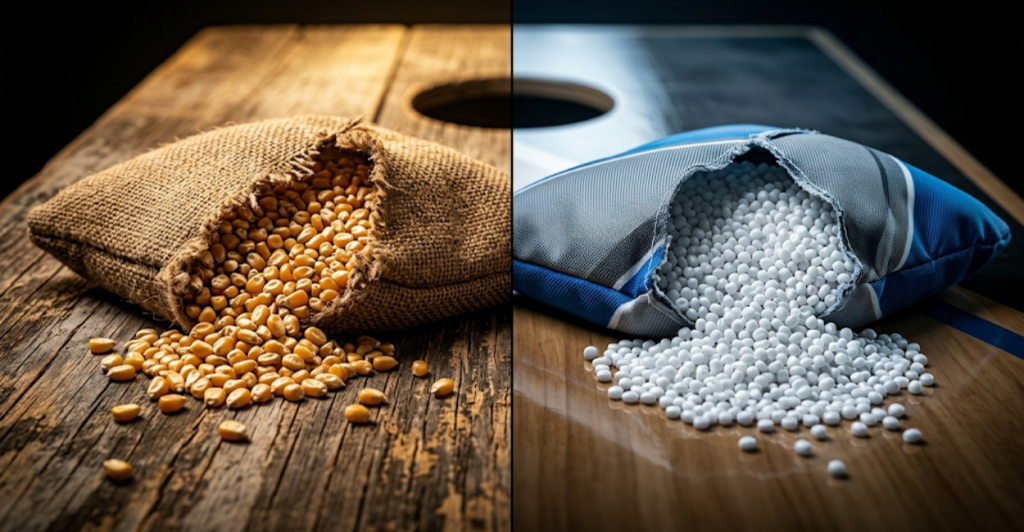
A Tale of Two Fills: How It All Started
Have you ever picked up a cornhole bag and wondered why some feel like tiny bricks?
Others crinkle like a bag of rice. The difference comes down to one thing. What is inside.
The fill material changes everything. It affects how the bag slides. How it stops. How it feels in your hand. And yes, whether you win or lose.
For decades, corn was the only option. The name gave it away. Cornhole. Simple and honest.
Then resin pellets arrived. Suddenly, the game changed forever.
Today, players argue passionately about which fill performs better. Some swear by the traditional feel of corn. They love the nostalgia. They trust what worked for their grandparents.
Others would never touch a corn-filled bag again. They prefer the consistency of resin. They want predictable performance in any weather.
So which one is right for you?
This guide breaks down everything you need to know. You will learn the science behind each fill, see real performance comparisons, and discover how weather, maintenance, and cost affect your decision.
Let me help you choose the perfect bag fill for your game.
Corn-Filled Bags: The Original Choice
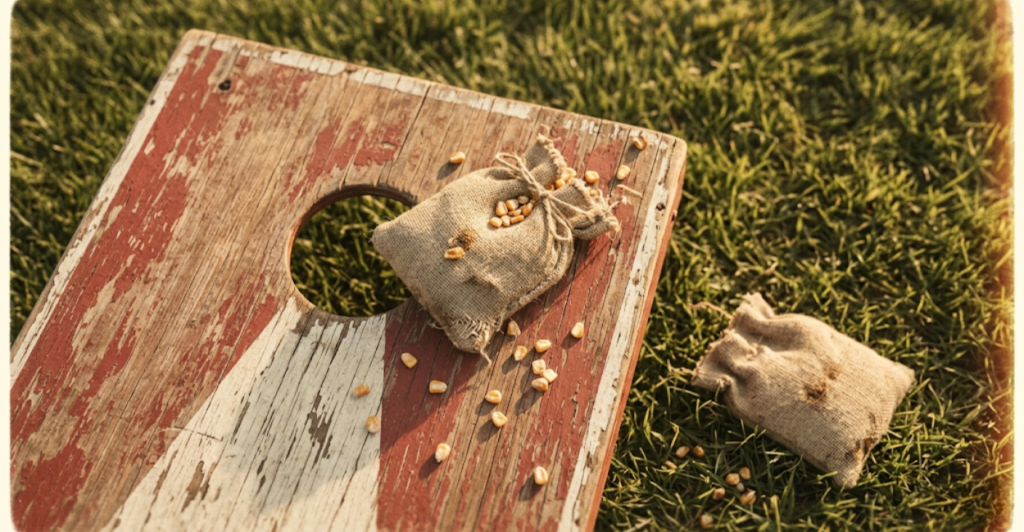
Corn has been inside cornhole bags since the beginning. The game’s very name comes from this simple ingredient.
A Brief History
According to the American Cornhole Organization’s official history, competitive cornhole began taking shape in 2005. But backyard players used corn-filled bags long before that.
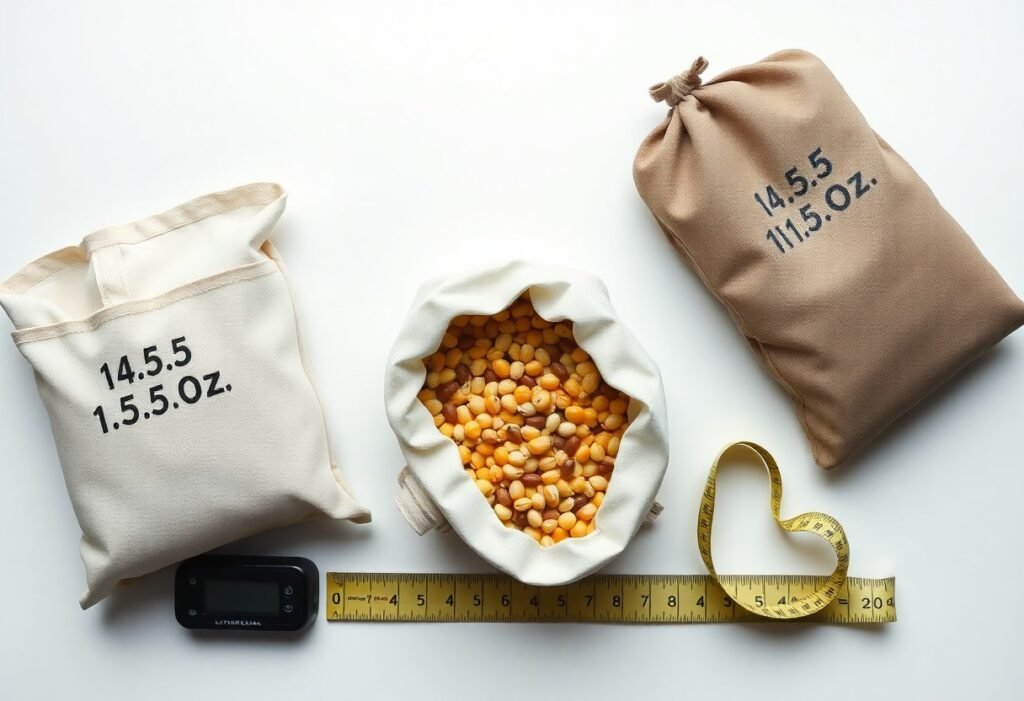
Dried feed corn was cheap and readily available. Families would fill burlap or duck cloth bags with corn kernels. Then they would stitch them shut by hand.
Those early bags were far from perfect. Corn would shift inside the bag. Kernels would break down over time. Moisture caused swelling and mold.
But players loved them anyway. The game worked. The bags felt right.
How Corn-Filled Bags Perform
Corn has natural friction. The kernels grip the board surface differently than synthetic materials.
The good: Corn bags offer excellent board feel. You can sense exactly when the bag grabs or slides. Many experienced players prefer this tactile feedback.
The bad: Corn consistency varies from bag to bag. Moisture changes everything. A dry corn bag plays completely differently than a humid one.
The ugly: Corn breaks down. Those kernels eventually turn into dust. Your expensive tournament bag becomes a flat floppy mess.
Who Still Uses Corn?
Serious competitive players rarely use corn anymore. The ACO history page notes that resin-filled bags were introduced back in 2006. That innovation changed professional play forever.
However, casual backyard players still love corn. The tradition matters. The feel is familiar. And for occasional weekend games, corn works just fine.
Resin-Filled Bags: The Modern Revolution
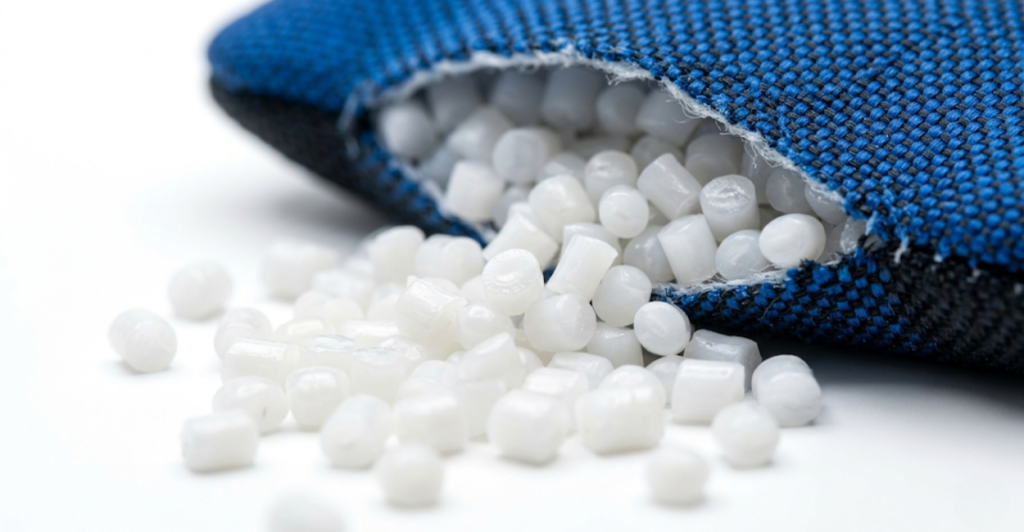
Resin pellets changed cornhole forever. These tiny plastic beads solved nearly every problem with corn.
The Innovation
According to the ACO official history, the organization introduced resin-filled cornhole bags in 2006. This was a groundbreaking moment for the sport.
Resin pellets are uniform. They do not absorb moisture or break down into dust, and they weigh exactly the same bag after bag.
The ACO also introduced two-sided playing surfaces in 2008. This gave players a “sticky” side and a “slick” side on the same bag. Resin made this innovation possible.
How Resin-Filled Bags Perform
Resin offers unmatched consistency. The pellets flow smoothly inside the bag. They settle predictably after each throw.
The good: Weather barely affects resin bags. Rain or shine, hot or cold, resin performs almost the same. The weight stays constant. The slide remains predictable.
The bad: Resin bags cost more. The manufacturing process is complex. You will pay $60 to $150 for quality resin bags.
The ugly: Some players say resin feels too artificial. They miss the organic feedback of corn. Resin can feel “dead” or “plastic-like” to traditionalists.
Who Uses Resin?
Nearly every professional player uses resin-filled bags. According to Popular Mechanics, pro player Anthony Ayon describes cornhole as being about “friction and strategy and decision-making scenarios.” Resin gives him the control he needs.
Serious amateurs also prefer resin. If you play in leagues or tournaments, resin is the standard choice.
Resin vs Corn: Head-to-Head Comparison Table
Let me show you how these two fills stack up side by side.
| Feature | Corn-Filled Bags | Resin-Filled Bags |
|---|---|---|
| Feel | Natural, organic, slightly grippy | Smooth, consistent, slightly slick |
| Weight consistency | Varies with moisture | Very consistent |
| Durability | Low (kernels break down) | High (pellets last years) |
| Weather resistance | Poor (absorbs moisture) | Excellent (waterproof) |
| Cost | $20-$50 per set | $60-$150 per set |
| Noise level | Quiet crinkling sound | Soft plastic rattle |
| Mold risk | High if wet | None |
| Professional use | Rare | Standard |
| Best for | Backyard casual play | League and tournament play |
How Fill Type Affects Your Game Performance
The fill inside your bag changes every throw. Here is what you need to know.
Slide Distance
Resin slides farther than corn. The plastic pellets create less friction against the board surface. Your shots will travel an extra foot or two with resin.
Corn grabs the board more. It stops quicker. This can help you control short shots but hurt you on long slides.
Bag Shape and Settling
Resin pellets flow easily. The bag flattens and conforms to the board surface. This creates more surface contact and predictable stopping points.
Corn kernels lock together. The bag stays rounder and bouncier. This makes blocking shots easier but slide shots harder.
Sound and Feedback
Corn bags make a satisfying crinkle. You hear the kernels shifting. Many players love this sensory feedback.
Resin bags rattle softly. The sound is quieter and less distinctive. Some players describe it as “plastic” or “cheap sounding.”
Professional Opinion
According to Popular Mechanics, pro players focus heavily on friction. Anthony Ayon explains that each bag has two different fabrics on either side. They call them “sticky” and “slick.”
Resin makes these fabric differences matter more. The fill does not interfere with the surface performance. Corn can mask some fabric characteristics.
Weather and Climate: The Hidden Factor
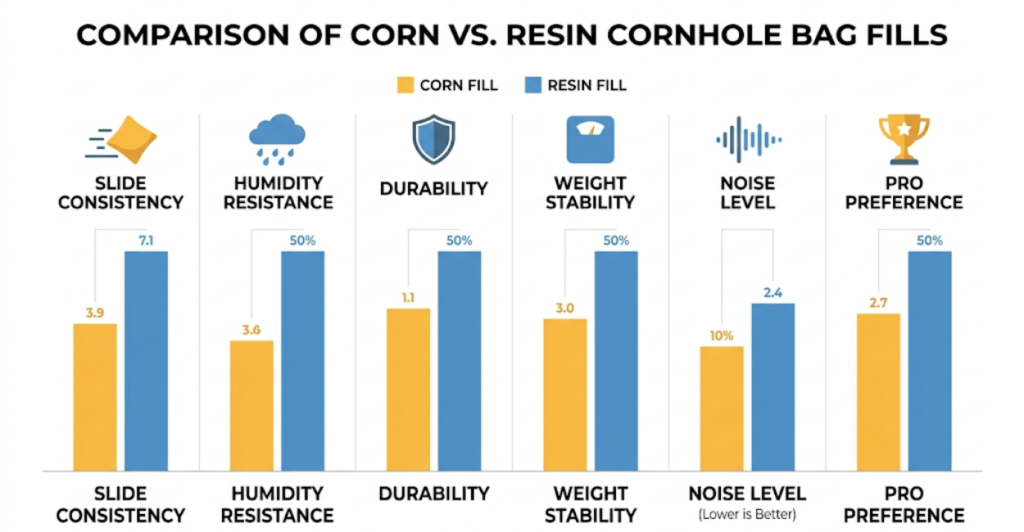
Weather changes everything with corn bags. Resin barely notices.
The Moisture Problem
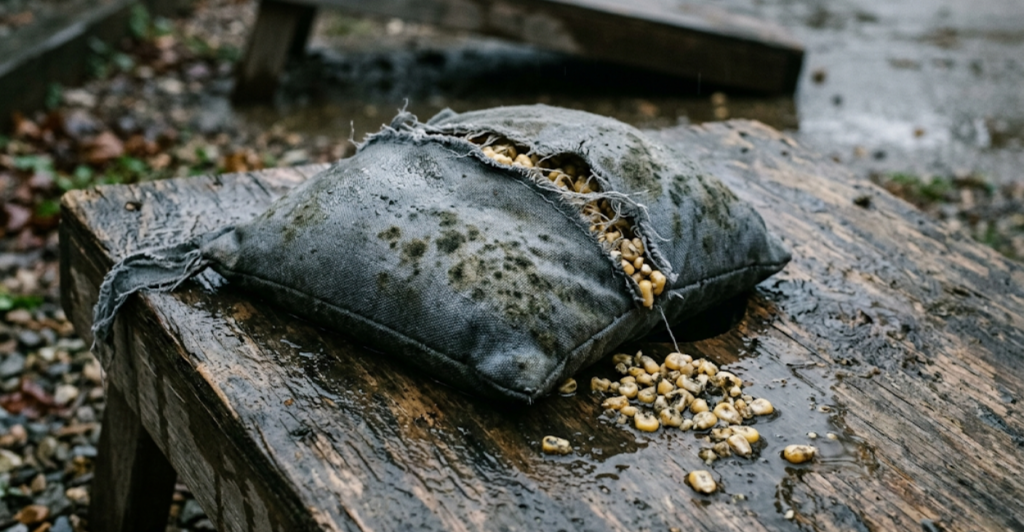
Corn absorbs water like a sponge. A single rainy tournament can ruin your expensive corn bags.
The kernels swell when wet. Your bag becomes heavier and misshapen. Mold grows quickly. The smell is unforgettable and unpleasant.
Resin pellets are plastic. Water rolls right off. You could submerge a resin bag and it would still play perfectly after drying.
Temperature Effects
Cold makes corn stiff. The kernels lock together. Your bag becomes hard and unresponsive. Winter games become frustrating.
Cold barely affects resin. The pellets remain flexible. Your bag plays almost the same at 40 degrees as it does at 80 degrees.
Heat dries out corn. The kernels shrink. Your bag loses weight. Performance becomes unpredictable.
Resin handles heat easily. The pellets do not change size or shape. Your bag stays consistent.
Humidity’s Impact
High humidity ruins corn bags. The kernels absorb moisture from the air. Your bag gains weight during a single afternoon of play.
Resin ignores humidity. The plastic pellets do not absorb anything. Your bag weighs the same at the start and end of the tournament.
According to the World Series of Cornhole, moisture significantly affects bag grip. Dry hands struggle to grip tightly. Sweaty hands create slippery surfaces. Resin eliminates the fill variable from this equation.
Bag Maintenance: Corn vs Resin
Taking care of your bags extends their life significantly.
Storing Corn Bags
Keep corn bags in a dry place. Moisture is your enemy. Use silica gel packets inside your bag storage container.
Never leave corn bags in a car. Temperature swings cause condensation. That moisture ruins the fill.
Check your corn bags regularly. Feel for hard spots or unusual softness. These signs indicate kernel breakdown.
Replace corn bags every season. The kernels degrade over time. Even with perfect care, corn bags have a limited lifespan.
Storing Resin Bags
Resin bags need almost no maintenance. Keep them dry and clean. That is basically it.
Wash resin bags occasionally. Use mild soap and water. Air dry completely before storing.
Resin bags last for years. Many players use the same resin bags for three or four seasons. The pellets never break down.
Cleaning Both Types
Spot clean corn bags with a damp cloth. Never soak them. Water destroys the fill.
Resin bags can handle gentle washing. Hand wash or use a delicate machine cycle. Air dry only. Heat damages the fabric.
When to Replace
Replace corn bags when:
- Kernels feel dusty or broken
- The bag shape becomes irregular
- Mold spots appear
- The bag smells musty
Replace resin bags when:
- The fabric tears or wears thin
- Pellets start leaking from seams
- The bag no longer holds its shape
Cost Comparison: Are Resin Bags Worth the Price?
Let me break down the real costs of each fill type.
Initial Purchase Price
| Bag Type | Price Range | Average Price |
|---|---|---|
| Corn-filled (casual) | $15 – $30 | $22 |
| Corn-filled (premium) | $35 – $55 | $45 |
| Resin-filled (entry) | $50 – $70 | $60 |
| Resin-filled (pro) | $80 – $150 | $110 |
Long-Term Value
Corn bags last one season with regular play. That is roughly 6 to 12 months. You will spend $45 per year on premium corn bags.
Resin bags last three to five seasons. That is 36 to 60 months. You will spend $110 once.
Five-year cost comparison:
- Corn bags: $45 × 5 = $225
- Resin bags: $110 × 1 = $110
Resin saves you over $100 across five years. The cheaper upfront price of corn is deceptive. You pay more in the long run.
Tournament Considerations
Professional players replace resin bags every season anyway. The fabric wears out before the fill does.
For casual players, resin still wins on value. You will not wear out resin bags for years.
Which Pro Players Use Which Fill?
Almost every professional player uses resin-filled bags. The competitive advantages are too significant to ignore.
ACL Pro Circuit
The American Cornhole League features resin bags exclusively at the pro level. Players need consistent performance across different venues and weather conditions. Resin delivers that consistency.
ACO Championships
The ACO World Championships have featured resin bags since 2006. The organization introduced this innovation and never looked back.
Notable Pro Endorsements
Professional players like Matt Guy and Anthony Ayon use resin bags. According to Popular Mechanics, Ayon describes the game as being about “friction and strategy.” Resin gives him the control he needs.
What About Corn?
You will not find corn bags at professional tournaments. The inconsistency makes them unreliable for high-stakes competition.
Some pros practice with corn bags. They believe the extra challenge sharpens their skills. But when money is on the line, they switch to resin.
Common Myths About Bag Fills (Debunked)
Let me clear up some confusion about cornhole bag fills.
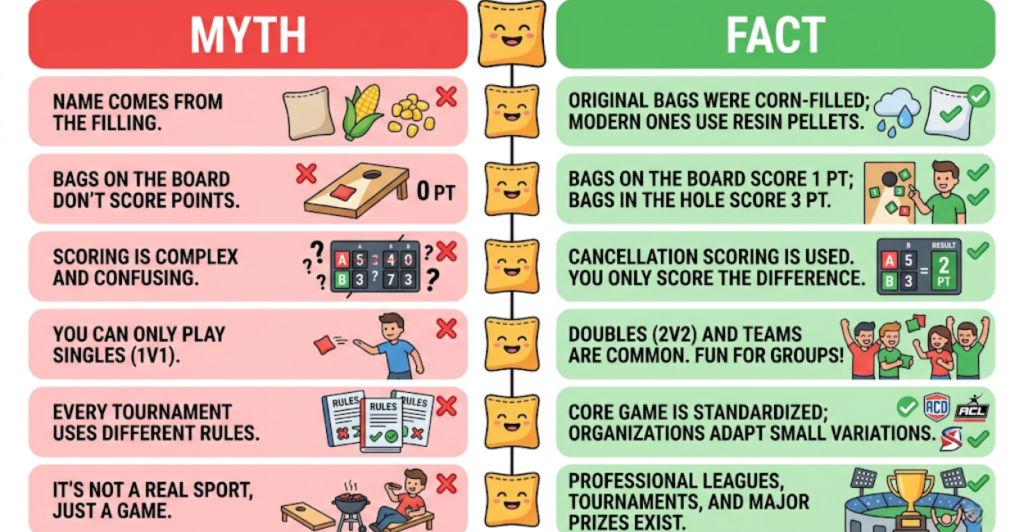
Myth #1: Corn bags are always cheaper.
Fact: Corn bags cost less upfront but more over time. You replace them every season. Resin lasts for years. Resin saves money in the long run.
Myth #2: Resin bags are illegal in some leagues.
Fact: Both the ACL and ACO allow resin bags. In fact, resin is the standard at professional events. No major league bans resin.
Myth #3: Corn bags have better grip.
Fact: Corn creates more friction naturally. However, resin bags can have grippy fabric surfaces. The fill matters less than the cover material.
Myth #4: Resin bags are too loud.
Fact: Resin makes a soft rattle. Corn makes a crinkling sound. Neither is loud. Most people cannot hear the difference from ten feet away.
Myth #5: You cannot use resin bags on humid days.
Fact: Resin handles humidity perfectly. The plastic pellets do not absorb moisture. Humid days actually affect corn bags more.
Myth #6: Professional players still use corn.
Fact: Almost no professional players use corn. The ACO introduced resin in 2006. Professionals have used resin exclusively for nearly two decades.
How to Choose: A Simple Decision Guide
Answer these questions to find your perfect bag fill.
Choose Corn-Filled Bags If:
- You play casually in your backyard once or twice a month.
- You love the traditional feel and sound of corn.
- You live in a dry climate with low humidity.
- You store your bags indoors in a climate-controlled space.
- You want the cheapest possible upfront cost.
- You play with friends who also use corn bags.
Choose Resin-Filled Bags If:
- You play in leagues, tournaments, or competitive settings.
- You live in a humid area or play in varying weather.
- You want consistent performance every time you throw.
- You plan to keep your bags for multiple seasons.
- You care about slide shots and advanced techniques.
- You want to use what the professionals use.
The Honest Truth
Most players should choose resin.
The advantages are overwhelming. Resin lasts longer, handles weather better, performs more consistently, and saves money over time.
Corn only wins on tradition and upfront price. If those matter more to you than performance, buy corn.
But if you want to play your best cornhole, resin is the answer.

Frequently Asked Questions (FAQ)
Can you mix corn and resin in the same bag?
Technically yes, but nobody does this. Mixed fills create unpredictable performance. The corn absorbs moisture while the resin does not. Your bag would change constantly.
Do resin bags damage cornhole boards?
No. Resin pellets are soft and smooth. They will not scratch or damage board surfaces. The fabric cover protects the board more than the fill.
How long do resin bags really last?
With casual play, resin bags can last five years or more. With competitive play, expect two to three years. The fabric wears out before the resin pellets break down.
Why do some people hate resin bags?
Tradition plays a big role. Some players grew up with corn. They love the sound, feel, and nostalgia. Resin feels artificial to these players. Performance does not matter as much as the experience.
Are there other fill types besides corn and resin?
Yes. Some manufacturers use plastic beads, sand, or synthetic blends. However, corn and resin dominate 95% of the market. Stick with these two proven options.
Which fill do ACL pros use?
ACL pros use resin almost exclusively. The ACL official website features resin bag manufacturers as sponsors. Corn does not appear at the professional level.
Can I switch from corn to resin easily?
Absolutely. Your throwing technique works the same. You may need a few games to adjust to the different slide distance. After that, you will never want to go back.
Final Thoughts: There Is No Wrong Fill
I have thrown thousands of bags in my life. Corn bags in backyards. Resin bags in tournaments. Both brought me joy.
The best fill is the one that makes you want to play.
Corn is honest and traditional. It feels right in your hand. It sounds like summer afternoons and family cookouts. Corn bags have soul.
Resin is precise and professional. It performs perfectly every time. It sounds like competition and victory. Resin bags have science.
Choose corn for the memories. Choose resin for the wins.
Or do what I do. Keep both. Use corn bags when playing with casual friends. Use resin bags when the score matters.
Either way, keep throwing. Keep having fun. Keep loving this wonderful game.
See you at the boards.
Sources & References
Official League Sources
- American Cornhole Organization Official History – ACO founding (2005), resin-filled bags introduced (2006), two-sided playing surfaces (2008), ACO Certified Officials (2010)
- American Cornhole League Official Homepage – League information, tournament structure, pro player sponsorships
Scientific & Educational Sources
- US Patent US20190344142A1: Cornhole Bag and Related Process – Friction coefficient science, dual-material bag surfaces, official cornhole equipment standards
- Popular Mechanics: 5 Tricks To Dominate a Game of Cornhole – Anthony Ayon on friction and strategy, sticky vs slick sides, professional player insights (published September 2022)
- World Series of Cornhole: The Science of Cornhole Bag Grip – Moisture effects on grip, surface texture impact, bag filling comparisons