
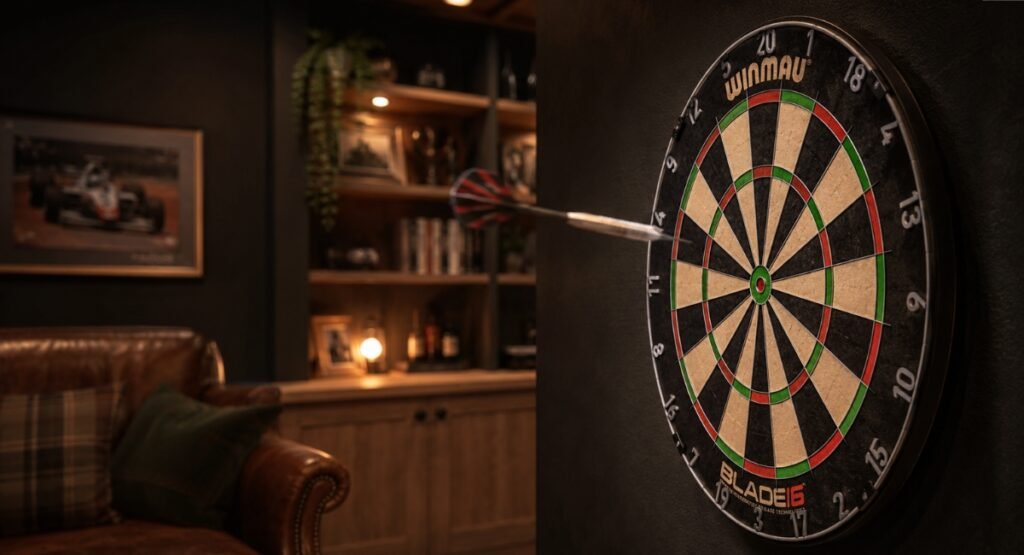
Picture this. It’s a Friday night. You’ve got a couple of friends over, everyone’s relaxed, and someone suggests a game of darts. You pull out that dusty old board from the garage — the one with the saggy wire, missing number ring, and sections that swallow darts whole — and the whole vibe deflates faster than a cheap balloon.
Sound familiar? You’re not alone.
The best dartboard for home use isn’t just about buying any old thing off a shelf. It’s about finding a board that fits your room, your skill level, your budget, and — critically — your household’s noise tolerance. Get it right, and darts becomes your go-to home game for years. Get it wrong, and you’ll be pulling rusty steel tips out of your drywall for the foreseeable future.
This guide covers everything. We’ve researched the top competitors, identified the gaps they missed (noise reduction, room-by-room advice, long-term care), and we’re giving you the full picture — from budget bristle boards to professional PDC-grade options, electronic boards for kids and flats, and the full setup guide that most articles skip entirely.
Let’s do this. 🎯
Why the Right Dartboard Makes All the Difference
You might think a dartboard is just a dartboard. Colourful circles on a wall — how complicated can it be?
Quite a bit, as it turns out.
The difference between a £20 board and a £120 board is enormous. We’re talking about bounce-out rates, sisal fibre quality, wire thickness, self-healing ability, and longevity. A cheap board wears out in months. A quality sisal board can last years of daily practice.
There are three main types to know before you buy anything:
- Bristle/Sisal boards — The gold standard. Made from compressed sisal fibres. Used in every pub, club, and professional tournament on the planet. Steel-tip darts only.
- Electronic/Soft-tip boards — Plastic segments with sensors. Automatic scoring, lots of built-in games. Great for families and beginners. Quieter for some setups, noisier for others.
- Magnetic boards — Foam surface, magnetic darts. Safe for young children. Not suitable for serious play.
Each has its place. But if you’re serious about darts — even casually serious — a bristle board is almost always the right choice for home use.
What to Look for When Buying a Dartboard for Home 🏠
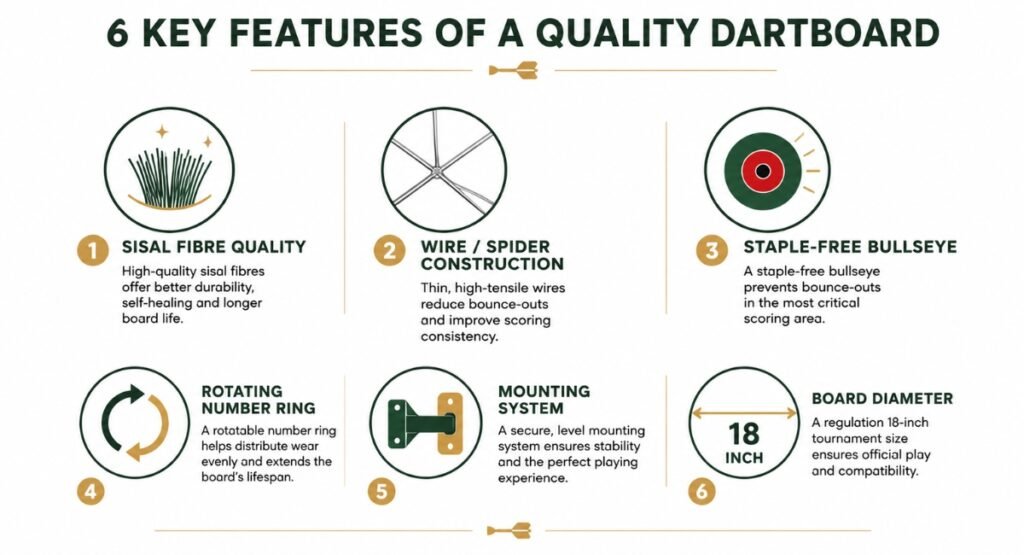
Before we jump into specific picks, here’s your buying checklist. These are the features that separate a great board from a frustrating one.
Sisal Fibre Quality
The best dartboards use compressed African Kenyan or Madagascan sisal fibres. These are denser, softer-facing, and more durable than cheaper alternatives. The softer outer layer lets the dart penetrate deeply, while the firmer inner core holds it in place. This also gives the board its famous self-healing property — when you remove a dart, the fibres close back up around the hole.
Look for boards that mention A-grade sisal or specific fibre counts. The Winmau Blade X, for example, packs over 5.5 million fibres per board.
Wire / Spider Construction
The wire is the metal framework dividing the scoring sections. This is where most bounce-outs happen. Thin, angled wire = fewer bounce-outs = higher scores = happier players.
The best modern boards use ultra-thin blade wire (rather than round wire) cut at a 60° angle. This design guides darts into the scoring zones rather than deflecting them out. It’s one of the biggest performance differences you’ll notice between budget and mid-range boards.
Staple-Free Bullseye
Many cheap boards are stapled around the bullseye, which means darts regularly bounce off the metal staples. All quality boards these days use a staple-free bullseye for a clean, consistent centre target.
Rotating Number Ring
Heavy use wears down certain segments faster — especially the 20, triple 20, and bullseye. A rotating number ring lets you turn the board slightly every few weeks, spreading wear evenly and dramatically extending the board’s life.
Mounting and Setup System
This one gets ignored constantly. How a board mounts to your wall affects noise, stability, and convenience. Look for boards with a simple, secure mounting bracket and ideally a pre-drilled thread or Rotafix-style system. Some boards include noise-dampening suspension systems that make a real difference in flats and semi-detached homes.
Board Diameter
Standard regulation size is 18 inches (45.7cm). Always buy a standard-size board. Anything smaller is a toy.
The Best Dartboards for Home Use: Our Top Picks 🎯
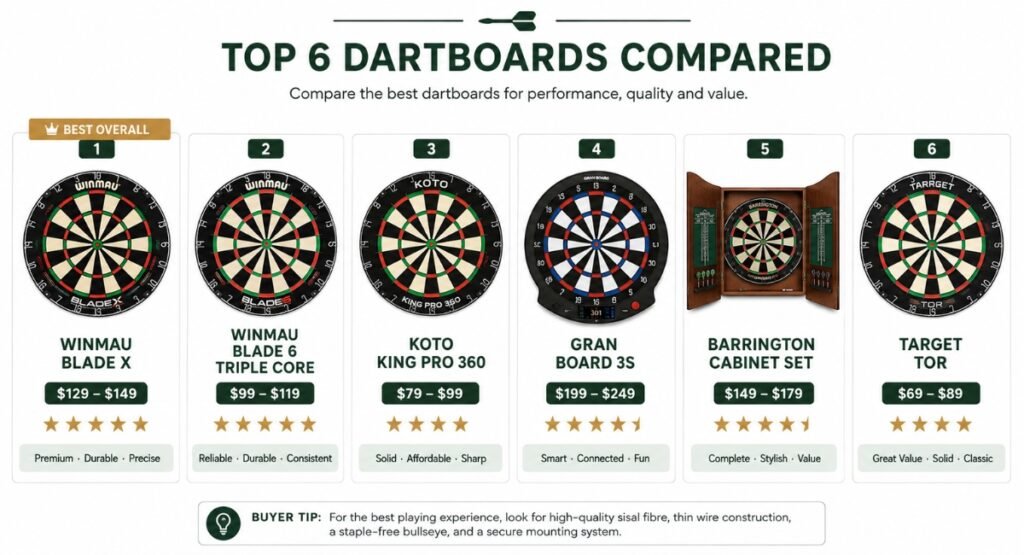
Here’s the honest breakdown by category. Every recommendation below is based on real-world performance, user experience, and professional standards.
🥇 Best Overall: Winmau Blade X
Best for: Serious home players, daily practice, PDC competition standard
The Winmau Blade X is currently the official dartboard of the PDC for all major tournaments, replacing the Blade 6 Triple Core Carbon from January 2026. That alone tells you everything.
What makes it exceptional? Everything, honestly.
The Pro Core Technology layers sisal at different densities — a softer outer layer reduces resistance on impact, while the denser inner core absorbs the dart and holds it firm. The result is fewer bounce-outs and a board that feels right on every throw.
The wire system uses the latest Blade X fusion technology. Each blade is embedded deeply into the sisal bonding system, which prevents protrusion over time — something that plagues older boards. The angled cut guides darts into scoring sections instead of deflecting them away.
On top of all that, the Blade X comes with a five-year manufacturer warranty — the first dartboard ever to do so. That’s Winmau putting their money where their mouth is.
It also ships with a High Grade Polymar Bezel (protecting the number ring), a layered hardwood backboard, a pre-drilled mounting thread, and a Fusion Flight Case. It’s a complete, premium package.
Price range: £120–£150
Verdict: If you’re serious about darts and want a board that will last years of intensive use, this is it. 🏆
🥈 Best Mid-Range: Winmau Blade 6 Triple Core Carbon
Best for: Regular home players, serious practice without the premium price
Before the Blade X arrived, the Blade 6 Triple Core Carbon was the PDC’s official board. It’s still one of the finest dartboards ever made.
The headline feature is the Triple Core Carbon construction, where the sisal is embedded in a carbon fibre glue compound. This holds the fibres in place better than any standard bonding system, delivering outstanding durability and consistent performance over time.
The Blade 6 uses African Kenyan sisal — softer, less brittle, and more durable than cheaper alternatives. The soft-facing surface allows the dart to penetrate deeply into the firmer sisal beneath, dramatically reducing bounce-outs, especially in crowded segments.
World Darts Federation approved. Regulation dimensions. Stunning performance.
Price range: £60–£90
Verdict: The Blade 6 is the sweet spot for any home player who practices regularly. Exceptional quality at a justifiable price. 🎯
🥉 Best Budget Pick: KOTO King Pro 360
Best for: Beginners, occasional players, first dartboard buyers
Not everyone needs a competition-grade board straight away. The KOTO King Pro 360 is the best entry point for home players who want to get started properly without overspending.
It features thin blade-style wiring, a staple-free bullseye, a rotating number ring, and official regulation dimensions — all features you’d expect only on pricier boards. The 360 in the name refers to the full rotation capability of the number ring.
For occasional games — a few times a month — this board performs excellently. It won’t self-heal as dramatically or last as long under daily heavy practice as the Winmau boards, but it’s a genuine, solid sisal dartboard at a genuinely accessible price.
Price range: £25–£40
Verdict: The best starting point for new players or casual home setups. Don’t be fooled by the price — this is a real sisal board, not a toy.
🌀 Best for Even Wear & Longevity: Winmau Blade 360 Triple Core
Best for: Players who hate dead spots, anyone wanting Blade 6-level performance with smarter rotation
This is the board almost every other buying guide forgets to mention — which is a shame, because it solves one of the most annoying long-term problems with bristle boards: uneven wear.
The Blade 360 takes the same proven Blade 6 Triple Core technology — the carbon-fibre reinforced base, the high-grade East African sisal, the ultra-thin professional wiring — and rebuilds it around a genuinely clever 360° symmetrical design. Instead of a single fixed orientation, the board has 10 perfectly balanced rotation points, meaning you can rotate it regularly and it always hangs the right way up, with branding and numbering staying perfectly aligned no matter which position you choose.
That sounds like a small thing. It isn’t. Most boards technically allow rotation, but the moment you turn them, the numbers end up sideways or upside down, so most home players simply never bother — which means the 20 and triple 20 segments wear out years before the rest of the board. The Blade 360 removes that excuse entirely. Ten clean rotation points means even, predictable wear distribution across the entire playing surface, which directly translates into a longer-lasting board.
Tournament Pedigree and Real-World Performance
It’s currently used across PDC floor events, Q School, the Challenge Tour, the Development Tour, and the Ladies Tour, so the on-board performance is exactly what you’d expect from Winmau’s flagship lineage — minimal bounce-outs, deep fibre penetration, and reliable self-healing. Owners consistently mention how quiet the board is on impact and how well it holds darts in busy segments like the trebles.
It also ships with a quick-fit mounting kit, making setup genuinely painless for a first-timer.

Price range: £85–£95
Price range: £85–£95
Verdict: If board longevity and even wear matter to you more than chasing the absolute latest flagship spec, the Blade 360 might be the smartest buy on this entire list. 🌀
🎯 Best for Families: Gran Board 3S Bluetooth Electronic Dartboard
Best for: Families with children, tech-savvy players, apartments, beginners who want automatic scoring

Electronic boards are a completely different experience — and for the right household, they’re brilliant.
The Gran Board 3S connects to your smartphone, tablet, or Smart TV via Bluetooth 4.0. The app handles all scoring automatically, tracks stats, and offers a huge range of built-in games beyond the standard 501 and Cricket. You can even play online against other players.
Because it uses soft-tip darts (plastic tips rather than steel), it’s much safer for younger players and there’s no risk of serious wall damage from bounce-outs. The soft tips also mean less impact noise on the board face itself — though the electronic sounds are a factor.
The board is regulation-size at 15.5 inches and sturdy enough for regular family use.
One honest note: electronic boards don’t replicate the feel of a steel-tip bristle board, and the plastic segments can crack or break over time. But for a family game room or flat where safety and automatic scoring matter more than professional accuracy, the Gran Board 3S is hard to beat.
Price range: £100–£150
Verdict: The best electronic option for home use. Perfect for families, beginners, and anyone who loves the social, connected side of darts. 📱
🎯 Best with Cabinet: Barrington Bristle Dartboard Cabinet Set
Best for: Living rooms, home bars, wall protection, organised setups
If aesthetics matter — and in a living room, they absolutely do — a dartboard cabinet transforms a functional board into a proper feature piece.
The Barrington Cabinet Set wraps a genuine A-grade sisal dartboard inside a basswood veneer cabinet with lockable doors. The cabinet serves multiple purposes: it protects your walls from stray darts, keeps everything organised (darts stored inside the doors), and gives your setup a polished pub-style look.
It includes six steel-tip darts with flights, a dry-erase scoreboard, a flip cricket scoring chart, and all necessary mounting hardware.
The doors open flat against the wall during play, and when closed, no-one walking past even knows there’s a dartboard behind them. For living rooms and home bars, this kind of discreet presentation genuinely matters.
The only honest criticism: the wire spider on the Barrington is slightly thicker than on premium boards, which means a marginally higher bounce-out rate. For regular casual play, though, you’ll barely notice it.
Price range: £60–£100
Verdict: The best complete home setup solution. Looks great, protects your walls, and arrives ready to play. 🎨
🎯 Best Professional Alternative: Target TOR
Best for: Players who want WDF-approved competition quality with modern aesthetics
The Target TOR has quietly become one of the most respected bristle boards on the market. It’s a real challenger to the Winmau dominance.
The TOR uses 215-MDG Madagascar sisal — specifically selected for strength and self-healing ability. The surface is hand-sanded for a smooth, consistent feel, and the 36XTEN rotation system offers ten fixed rotation positions, making it easier to distribute wear evenly than boards with free-spin number rings.
The Peak-Fix mounting system ensures stable installation even on uneven walls — a real practical advantage for older homes. World Darts Federation approved.
Aesthetically, the TOR has a more modern, premium look compared to traditional boards. If you want competition quality with a contemporary finish, this is your board.
Price range: £80–£110
Verdict: An excellent alternative to the Winmau range. WDF-approved, premium sisal, and practical mounting. If you like the design and the Target brand, you won’t be disappointed.
Dartboard Comparison Table 📊
| Board | Type | Price Range | Best For | WDF Approved | Warranty |
|---|---|---|---|---|---|
| Winmau Blade X | Bristle/Sisal | £120–£150 | Daily serious practice | ✅ | 5 years |
| Winmau Blade 360 Triple Core | Bristle/Sisal | £85–£95 | Even wear / longevity | ✅ | 1 year |
| Winmau Blade 6 Triple Core | Bristle/Sisal | £60–£90 | Regular home players | ✅ | 1 year |
| KOTO King Pro 360 | Bristle/Sisal | £25–£40 | Beginners / occasional play | ✅ | 1 year |
| Gran Board 3S Bluetooth | Electronic | £100–£150 | Families / tech players | ❌ | 1 year |
| Barrington Cabinet Set | Bristle/Cabinet | £60–£100 | Living rooms / home bars | ✅ | 1 year |
| Target TOR | Bristle/Sisal | £80–£110 | Serious players / WDF | ✅ | 1 year |
How to Set Up Your Dartboard Correctly 🔧
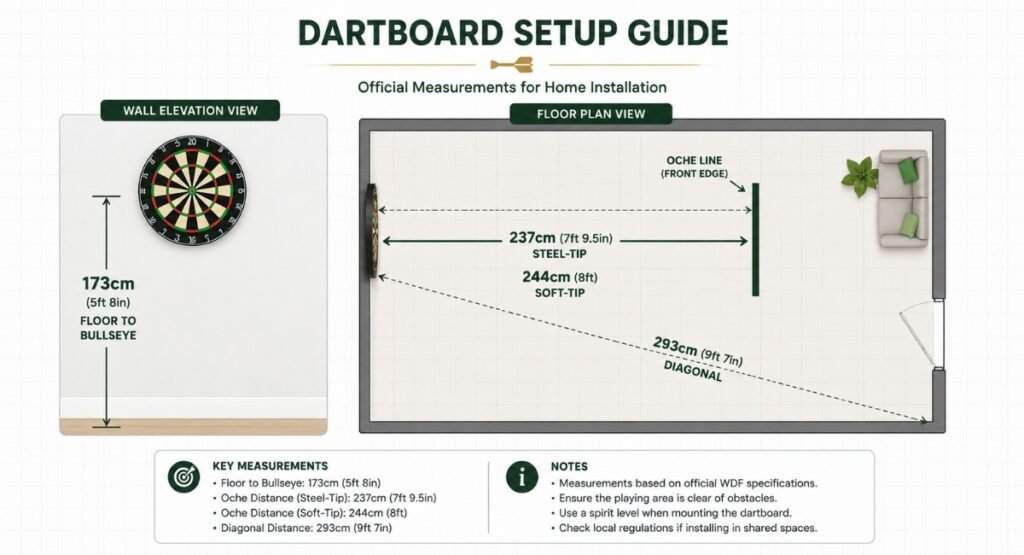
This is where most buying guides fall completely flat. They tell you what to buy, then leave you staring at a box wondering what to do next.
Here’s the complete setup guide.
Official Dartboard Height and Distance
These measurements are set by the British Darts Organisation (BDO) and World Darts Federation (WDF) and used in every pub, club, and tournament worldwide:
- Bullseye height: 173 cm (5 feet 8 inches) from the floor
- Throwing distance (oche): 237 cm (7 feet 9¼ inches) for steel-tip darts
- Throwing distance (oche): 244 cm (8 feet) for soft-tip/electronic darts
- Diagonal measurement: 293 cm from bullseye to oche (useful for checking both at once)
Use a spirit level when marking your bullseye height. Floors are rarely perfectly level, so measure from the floor at the wall, not from any nearby furniture.
Step-by-Step Mounting Guide
- Mark your bullseye height (173 cm) on the wall with a pencil.
- Use a stud finder to locate wall studs near your mark.
- For stud mounting, use 3-inch wood screws with 1.5–2 inches of penetration into the stud.
- For drywall without stud access, use toggle bolt anchors rated for your board’s weight.
- Attach the mounting bracket to the board’s back, centred and secure.
- Hang the board and double-check your bullseye height with a tape measure.
- Mark your oche (throwing line) on the floor with tape, a rubber mat, or a proper oche strip.
Pro tip: If you’re setting up in a room with carpet, a floor protector mat at the oche position prevents wear and gives you a consistent throwing position to come back to every session.
Avoid These Common Setup Mistakes
- Mounting on a shared wall next to a bedroom — the impact noise travels straight through.
- Mounting on drywall without anchors — a heavy sisal board will pull out over time.
- Skipping the oche mark — throwing from inconsistent distances makes your practice meaningless.
- Not rotating the board — failing to rotate causes uneven wear and shortens board life dramatically.
The Noise Problem: How to Make Your Dartboard Quieter 🔇
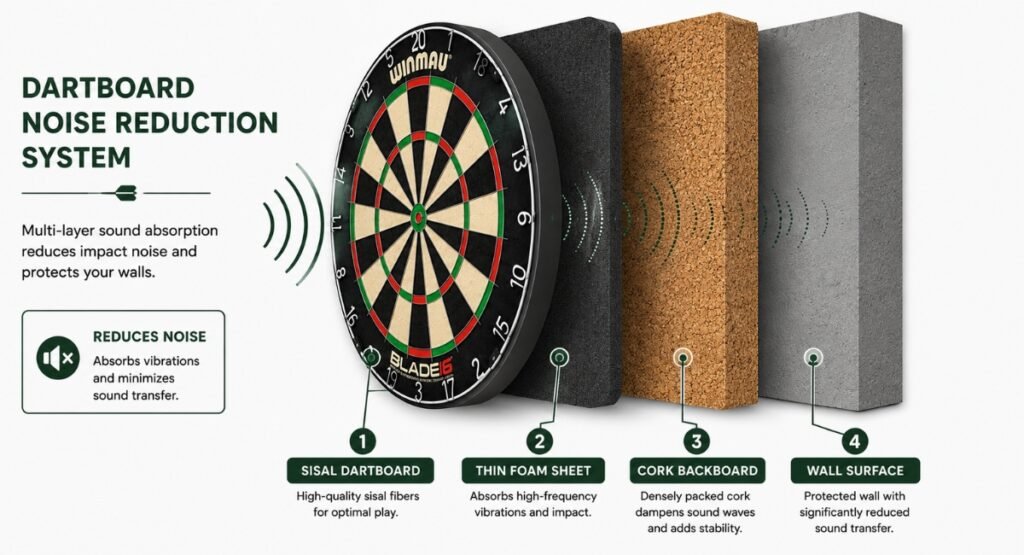
This is the topic that almost every competitor article ignores or barely mentions. But if you live in a flat, a terraced house, or just have people sleeping nearby, it matters enormously.
When a steel dart hits a sisal board mounted directly on a wall, the impact sound travels straight through the board, through the wall, and into the room beyond. In a hollow drywall setup, this can sound surprisingly loud on the other side.
Here are the most effective solutions, from simplest to most comprehensive:
Option 1: The Winmau WISPA System
The Winmau WISPA is specifically designed for this problem. It mounts your board on a system of tension cables and screws, suspending it approximately half an inch from the wall. Because the board is decoupled from the wall surface, vibrations can’t transfer directly through the structure. Users report it makes the biggest single noise reduction of any method — essentially eliminating the resonance in adjacent rooms.
Cost: approximately £60–£70. Absolutely worth it if noise is your primary concern.
Option 2: Cork or Foam Backboard
A layer of cork board or dense foam between the dartboard and the wall acts as a sound buffer. The foam absorbs vibrations before they reach the wall surface. A thin foam sheet attached directly to the back of the dartboard fills air gaps and prevents hollow resonance.
DIY version: Cut ¾-inch plywood to at least 36″ x 36″. Layer with corkboard or foam, then attach to the wall. This also protects against stray darts and gives the setup a polished look.
Option 3: Mass-Loaded Vinyl (MLV)
MLV is a heavy, dense material designed specifically for soundproofing. Placed behind the backboard, it blocks sound transmission through the wall more effectively than foam or cork alone. It’s a more serious investment but delivers measurable results — particularly useful if you’re renting and can’t modify walls permanently.
Option 4: Mount on an Exterior Wall
If your room layout allows, exterior-facing walls are significantly thicker and better at absorbing impact noise than interior partition walls. This alone can resolve most noise issues without any additional treatment.
Option 5: Switch to Soft-Tip Darts
If you use an electronic board or can play with soft tips on a convertible board, soft-tip darts produce noticeably less impact noise. The plastic tips don’t penetrate the surface with the same force, and the absence of a metal point reduces that sharp thwack sound significantly.
Noise Reduction Comparison
| Method | Cost | Effectiveness | DIY Friendly |
|---|---|---|---|
| Winmau WISPA System | £60–£70 | ⭐⭐⭐⭐⭐ | ✅ Easy |
| Cork/Foam Backboard | £10–£30 | ⭐⭐⭐⭐ | ✅ Easy |
| Mass-Loaded Vinyl | £30–£60 | ⭐⭐⭐⭐ | ⚠️ Moderate |
| Exterior Wall Mounting | £0 | ⭐⭐⭐ | ✅ Easy |
| Soft-Tip Darts | £10–£30 | ⭐⭐⭐ | ✅ Easy |
| Acoustic Panels | £40–£100 | ⭐⭐⭐ | ⚠️ Moderate |
Room-by-Room Dartboard Guide 🏡
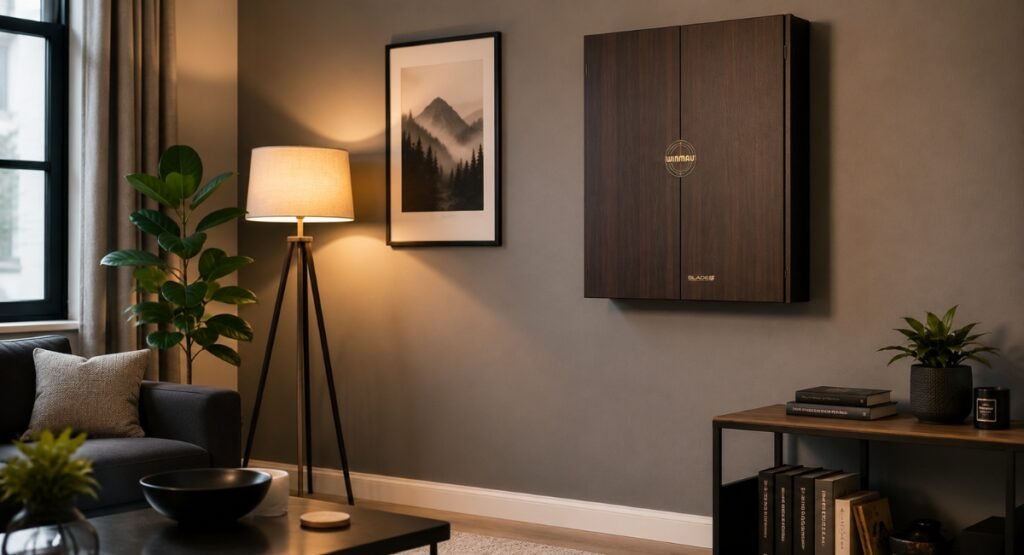
Most buying guides treat every home setup as identical. They’re not. Here’s what actually works room by room.
Living Room
Best choice: Cabinet set (like the Barrington) or the Target TOR with a quality surround.
The priority here is aesthetics and noise. A cabinet keeps things tidy and closed when not in use. Pair it with a cork or foam backboard behind the cabinet to handle noise. Make sure the throwing line won’t put players in the middle of furniture traffic.
Dedicated Game Room or Man Cave
Best choice: Winmau Blade X or Blade 6 Triple Core Carbon with full surround.
If you’ve got a room dedicated to games, go for the best board you can afford. Proper flooring (hard floor or a dedicated mat), good lighting over the board, and a wall-mounted scoreboard elevate the experience completely.
Garage or Shed
Best choice: Any bristle board, prioritising durability over aesthetics.
Garages and sheds are the classic dart practice space. Watch out for temperature fluctuations — extreme cold dries out sisal fibres and causes cracking. Don’t mount on an exterior wall that gets direct cold overnight if possible. A good surrond and a basic cabinet door setup works perfectly.
Flat or Apartment
Best choice: Gran Board 3S electronic board, or a sisal board with the Winmau WISPA system.
Noise is the priority in shared buildings. Soft-tip electronic boards are inherently quieter on the board face. If you prefer the bristle experience, the WISPA system is non-negotiable. Always mount on an exterior wall, never on a shared party wall.
Family Home with Children
Best choice: Gran Board 3S or a magnetic board for very young children.
Electronic boards with soft-tip darts remove the safety risk entirely for younger players. The automatic scoring keeps everyone engaged and removes the need to teach scorekeeping from day one. As children get older and more confident, transition them to a quality sisal board.
How to Make Your Dartboard Last Longer 🔄
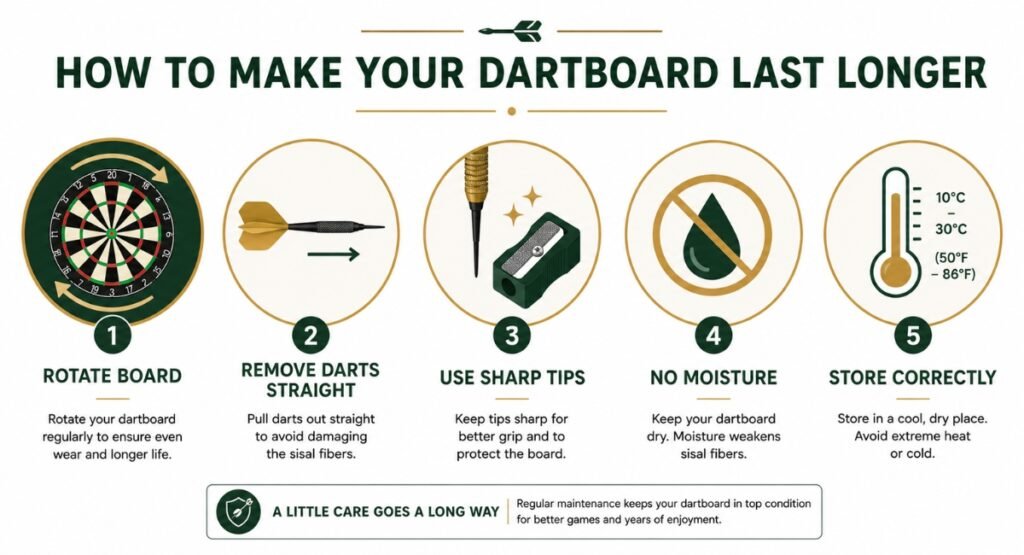
A quality sisal board is an investment. Here’s how to protect it.
Rotate the board regularly. Turn the number ring every 2–4 weeks of regular play. The 20 and triple 20 segments take the vast majority of throws, so rotating spreads the wear. A board rotated consistently can last 2–3 times longer than one left fixed.
Remove darts correctly. Pull darts straight out, not at an angle. Twisting or yanking darts at angles tears the sisal fibres permanently rather than letting them self-heal.
Use sharp dart points. Counterintuitively, blunt points cause more damage. Sharp points slide between fibres cleanly; blunt points tear them apart. Invest in a dart point sharpener — they cost almost nothing and preserve your board considerably.
Keep moisture away. Never spray water on a sisal board to “revive” it — this is old advice that causes swelling and warping. A quality board shouldn’t need moisture treatment.
Don’t leave darts in the board overnight. Leaving darts embedded compresses the fibres in those spots permanently. Remove darts after every session.
Store correctly in cold environments. If your garage drops below freezing in winter, consider storing the board indoors overnight. Prolonged freezing dries out sisal fibres irreversibly.
Dartboard Accessories Worth Having 🎯
You don’t need accessories to enjoy darts, but the right ones genuinely improve your home setup.
Dartboard surround: A foam or rubber ring around the board catches stray darts and protects your wall. Essential for beginners or anyone who throws with friends who aren’t exactly precision machines.
Dartboard cabinet: Combines a surround with door-based wall protection and dart storage. The definitive aesthetic upgrade for any living room or home bar.
Floor mat / oche strip: Defines your throwing position, protects your flooring, and gives you a consistent standing reference. Look for mats with the oche position pre-marked.
Scoreboard: A simple chalk or dry-erase board mounted nearby. Some people use apps; a physical scoreboard has a tactile, pub-style feel that’s part of the experience.
Dart sharpener and tip replacer: Cheap, small, and genuinely useful. Keep your steel points sharp for cleaner board penetration, and keep spare soft tips if you use an electronic board.
Good lighting: This one is underrated. A dedicated dartboard light (a horseshoe-shaped light that mounts above the board) eliminates shadows across the scoring segments and makes a real difference to precision.
Quick Reference Cheat Sheet 📋
| What You Need | Our Pick | Price Range |
|---|---|---|
| Best overall bristle board | Winmau Blade X | £120–£150 |
| Best for even wear/longevity | Winmau Blade 360 Triple Core | £85–£95 |
| Best mid-range | Winmau Blade 6 Triple Core | £60–£90 |
| Best budget | KOTO King Pro 360 | £25–£40 |
| Best electronic | Gran Board 3S Bluetooth | £100–£150 |
| Best cabinet set | Barrington Cabinet Set | £60–£100 |
| Best noise system | Winmau WISPA | £60–£70 |
| Bullseye height | 173 cm / 5ft 8in | — |
| Steel-tip throwing distance | 237 cm / 7ft 9¼in | — |
| Soft-tip throwing distance | 244 cm / 8ft | — |
| Board rotation schedule | Every 2–4 weeks | — |
Frequently Asked Questions ❓
What is the best dartboard for a beginner at home?
For absolute beginners, the KOTO King Pro 360 hits the sweet spot perfectly. It’s a genuine sisal board with regulation dimensions, thin wiring, and a rotating number ring — all the features that matter — without the premium price. As you develop, you can always upgrade. Alternatively, the Gran Board 3S electronic is ideal if you want automatic scoring from day one, or the Winmau Blade 360 if you want a board that grows with you and stays balanced for years without dead spots.
What is the difference between a bristle dartboard and an electronic dartboard?
A bristle dartboard is made from compressed sisal fibres and uses steel-tip darts. It’s the professional standard, used in all pubs, clubs, and tournaments. It requires manual scoring. An electronic dartboard uses soft-tip plastic darts that trigger sensors in plastic segments, providing automatic scoring and built-in games. Electronic boards suit families and beginners; bristle boards suit serious players and traditionalists.
How high should a dartboard be mounted on the wall?
The bullseye should be exactly 173 cm (5 feet 8 inches) from the floor. This is the regulation height set by the World Darts Federation and used in every professional and amateur competition worldwide. Always measure from the floor at the wall, not from nearby furniture, as floors are rarely perfectly level.
How far should you stand from a dartboard?
For steel-tip darts, the throwing line (oche) should be 237 cm (7 feet 9¼ inches) from the face of the board. For soft-tip darts and electronic boards, the distance increases slightly to 244 cm (8 feet). Mark the oche clearly with tape or a mat for consistent practice.
How do I reduce dartboard noise in a flat or apartment?
The most effective single solution is the Winmau WISPA suspension system, which decouples the board from the wall using tension cables and reduces noise transmission by a significant margin. Combined with a foam or cork backboard and mounting on an exterior wall (not a shared party wall), you can play late into the evening with minimal disturbance. Switching to soft-tip darts on an electronic board is also an effective option.
How long does a dartboard last?
A quality sisal bristle board from brands like Winmau or Target, with proper rotation every 2–4 weeks and regular maintenance, can last 3–5 years of regular home use. Daily intense practice — several hours a day — will shorten that, but occasional to regular home play should see you getting many years from a good board. Cheap boards with thicker wiring and lower-grade sisal typically last 6–18 months before developing dead spots and worn zones.
Do I need a dartboard cabinet?
You don’t need one, but a cabinet is strongly recommended for living rooms and home bars. It protects your walls from stray darts, keeps your darts organised and stored, looks significantly better than a bare board on a wall, and adds a pub-style character to any room. For garages, game rooms, or dedicated practice spaces, a simple surround is usually sufficient.
What type of darts should I use with a home bristle board?
For home bristle boards, use steel-tip darts. A good starting weight is 21–24 grams for most adult players. Tungsten barrels (90–97% tungsten) are slimmer and allow tighter groupings than nickel-silver or brass alternatives. Never use soft-tip plastic darts on a sisal board — they’re designed for electronic boards and won’t penetrate the fibres properly.
Final Thoughts: The Dart Is in Your Court 🎯

There’s genuinely no reason not to have a proper dartboard at home. The game is inexpensive to get into, endlessly social, surprisingly good practice for focus and concentration, and — with the right setup — completely unobtrusive in any room of the house.
If you take nothing else from this guide, take this:
Buy the best sisal board your budget allows. The Winmau Blade 6 Triple Core Carbon is the sweet spot for most home players. If you’re serious and practise daily, stretch to the Blade X. If you’re just starting out, the KOTO King Pro 360 is all you need. And if you’ve got a family or a flat, the Gran Board 3S electronic board changes the whole experience.
Sort your mounting setup, mark your oche, rotate the board, and keep those dart tips sharp. Do those things, and you’ll be hitting treble 20s before you know it.
Now go set it up. 🎯
Did this guide help you choose the right dartboard? Drop your pick in the comments below — we’d love to know which board you went for and how it’s working out in your setup. And if a friend is about to buy a dartboard, share this with them. Save them from making the expensive mistake of buying the wrong one.
For more on professional dartboard standards and WDF regulations, visit the World Darts Federation official site.


