

You Can Learn Cornhole in 5 Minutes
Cornhole looks complicated. It is not.
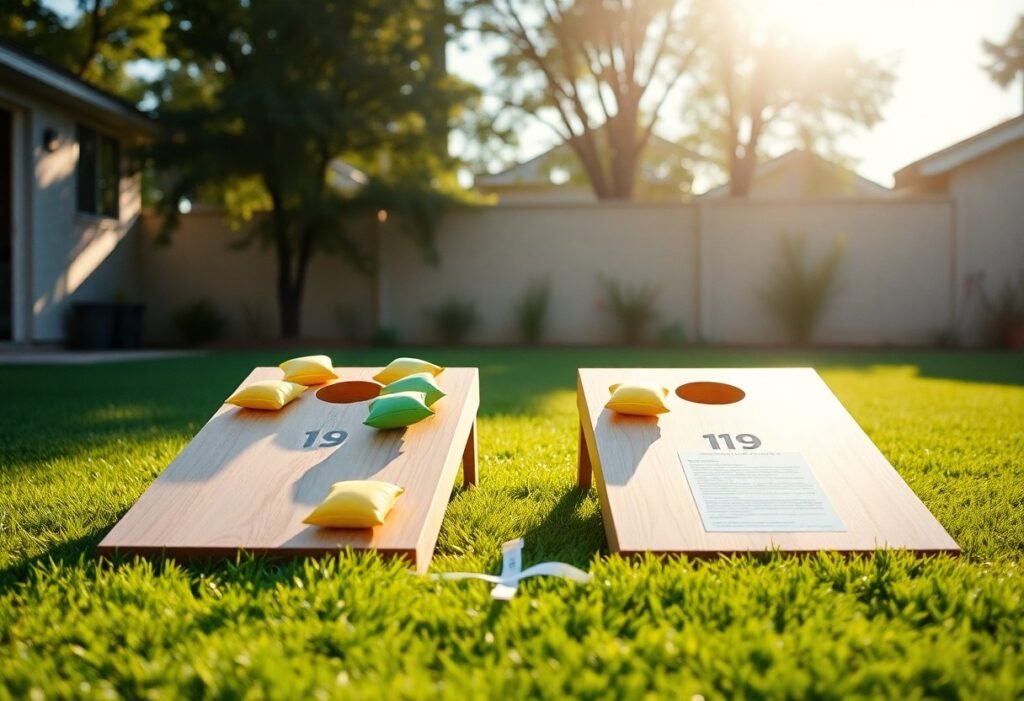
Two boards. Eight bags. One simple goal.
Get your bags on the board. Get them in the hole. Score more points than the other team.
That is the whole game.
This guide explains everything a beginner needs to know. No confusing terms. No advanced strategies. Just the simple rules that get you playing today.
By the time you finish reading, you will know how to set up, throw, score, and win.
Let us get started.
What You Need to Play
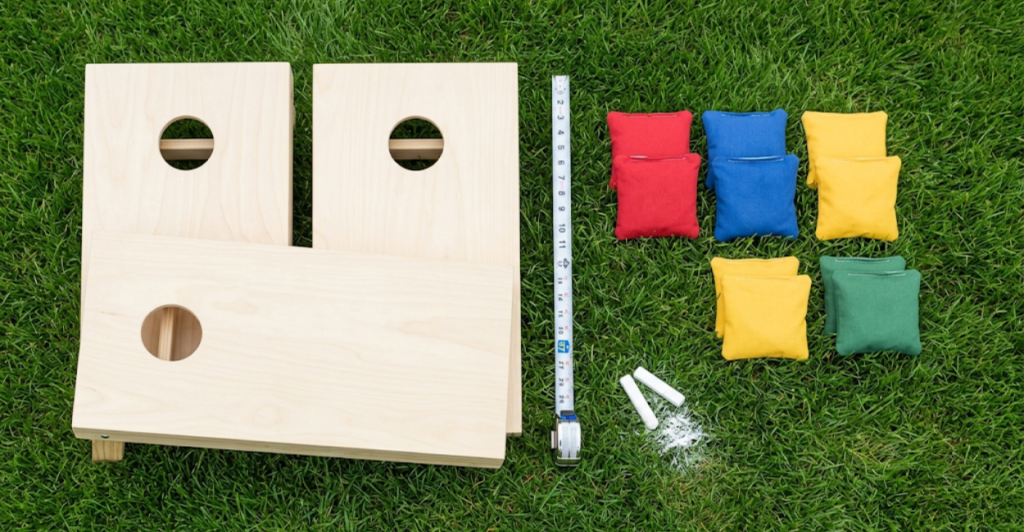
Gather these items before your first game.
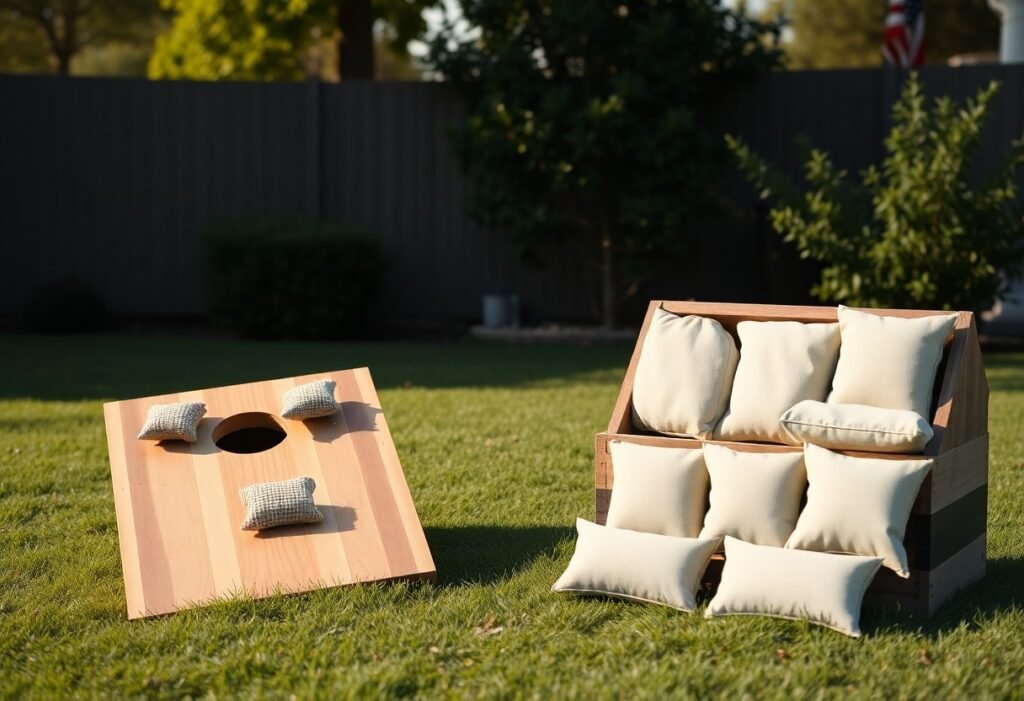
Two Cornhole Boards
Each board measures 2 feet wide by 4 feet long. A 6‑inch hole sits near the back edge.
For backyard play, any boards work. Regulation size is nice but not required. Borrow from a friend or buy an inexpensive set.
Eight Cornhole Bags
Each team gets four bags of the same color.
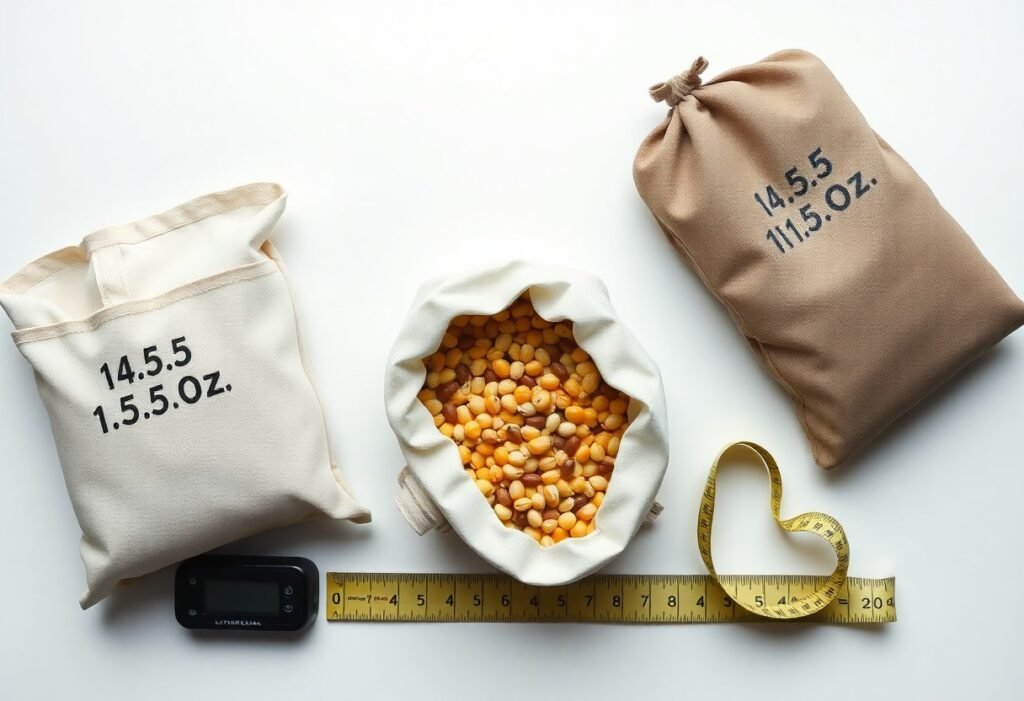
Standard sets include two colors (red vs blue, or yellow vs black). Professional bags weigh 15‑16 ounces. Casual bags can be lighter.
A Flat Playing Area
You need roughly 35 feet of length and 10 feet of width.
Grass works fine. Concrete or pavement works too. Just ensure the surface is mostly flat.
A Measuring Tool (Optional)
A tape measure helps set the official distance. For casual play, stepping it off works well.
Chalk or Markers (Optional)
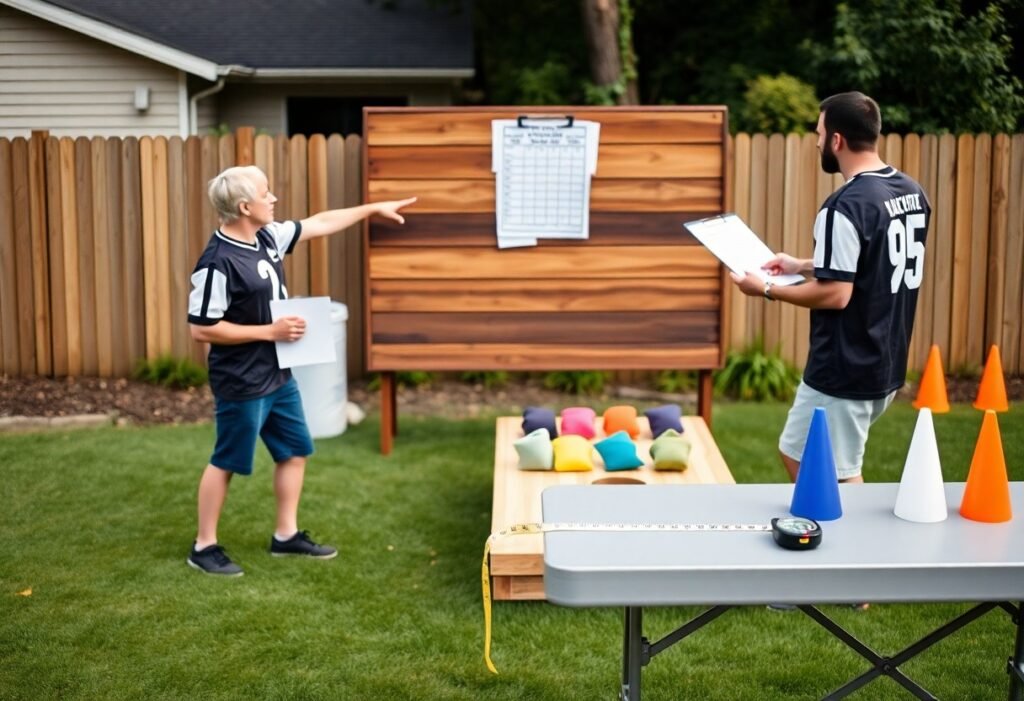
Mark the pitcher’s boxes and foul lines for serious games. Backyard players usually skip this.
That is everything. No other equipment is required.
Setting Up the Game
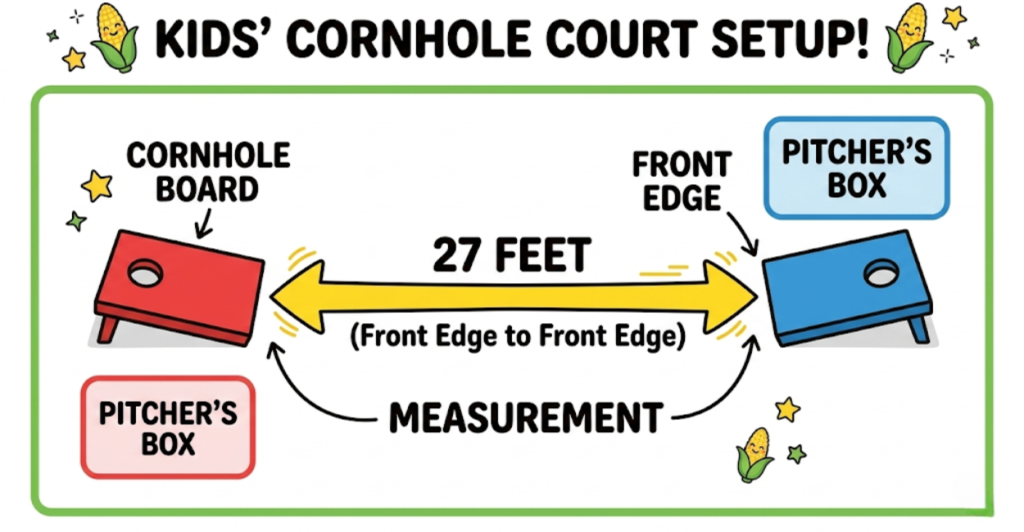
Proper setup takes two minutes.
Step 1: Place the Boards
Position the two boards facing each other.
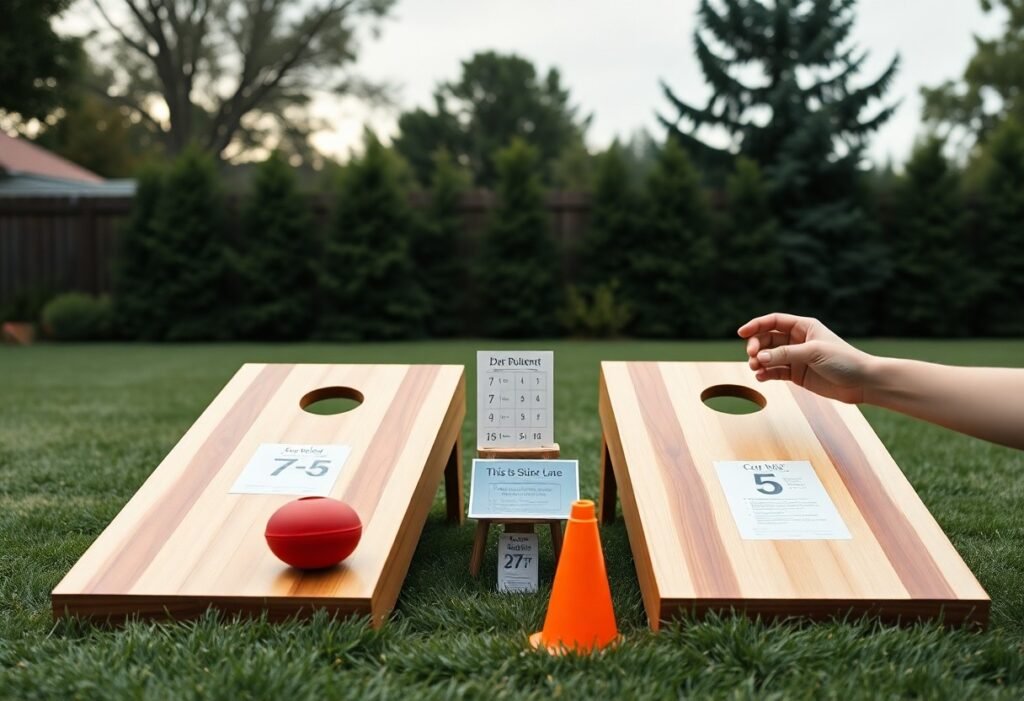
Measure 27 feet from the front edge of one board to the front edge of the other board. This is the regulation distance.
For casual play or children, move the boards closer. Twenty feet works well for beginners. Fifteen feet works for young kids.
Step 2: Mark the Throwing Areas
Each board needs a pitcher’s box. This is where players stand when throwing.
The box starts at the front edge of the board and extends 3 feet back. It is 4 feet wide, centered with the board.
For backyard games, simply mark an area with chalk or remember where to stand.
Step 3: Split into Teams
Cornhole is usually played with two teams of two players.
Each team stands on opposite sides, one player at each board.
Partners face each other across the court.
Step 4: Choose Who Goes First
Flip a coin. Rock paper scissors works too.
The winning team throws first.
Step 5: Decide the Winning Score
Standard games go to 21 points.
For shorter games, play to 15 or 11. For longer games, play to 25.
Agree before starting.
How to Throw a Cornhole Bag
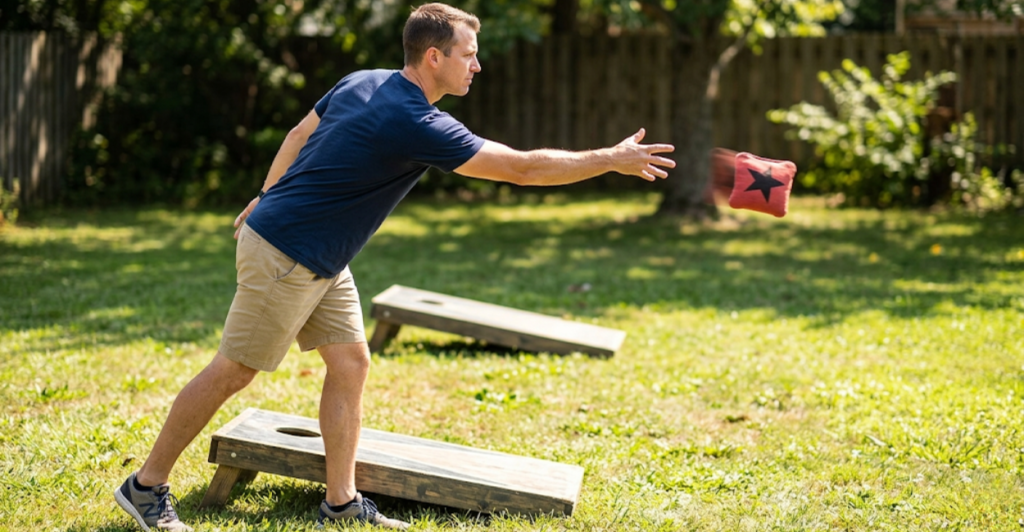
Good throwing technique makes the game more fun.
The Grip
Hold the bag with your fingers, not your palm.
Pinch the bag between your thumb and middle finger. Your index finger can rest on top for control.
Do not squeeze too hard. A relaxed grip works better.
The Stance
Stand behind the front edge of your board.
Your feet should stay behind this line until the bag leaves your hand.
Most players stand with their throwing foot slightly forward. Do whatever feels comfortable.
The Throw
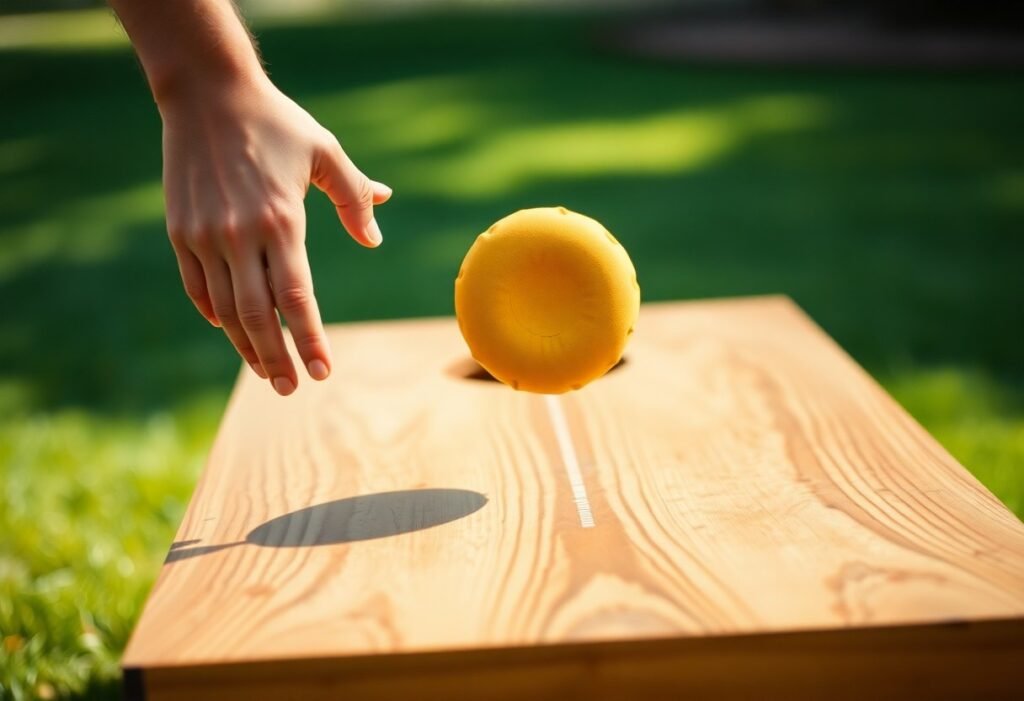
Use an underhand motion.
Bring your arm back. Swing it forward smoothly. Release the bag at about waist height.
Aim for the hole. Most beginners aim too high. The hole is lower than you think.
Do not throw hard. A gentle arc works best. The bag should land softly on the board.
Practice Tips
Start close. Practice from 15 feet before moving back to 27 feet.
Throw all four bags before retrieving them. This saves walking time.
Watch where your bag lands. Adjust your aim on the next throw.
Scoring Made Simple
Scoring confuses many beginners. It is actually very simple.
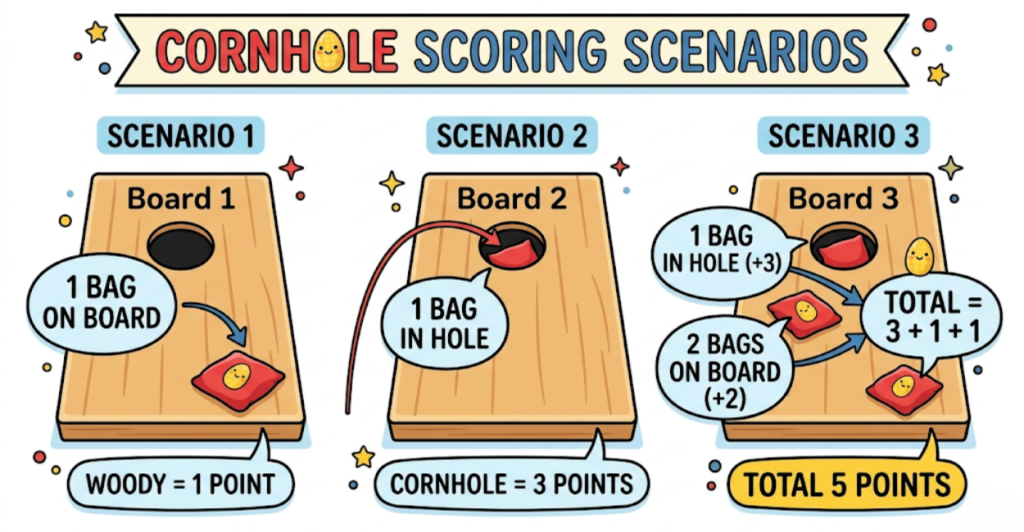
The Woody (1 Point)
A bag that lands on the board scores 1 point.
The bag must stay on the board. Any bag touching the ground scores zero.
If a bag hangs over the edge but does not fall, it counts as a woody.
The Cornhole (3 Points)
A bag that goes through the hole scores 3 points.
The bag must fall completely through. Bags stuck in the hole still count as 3 points.
No Points
Bags on the ground score nothing. If a bag hits the ground before landing on the board, it also scores nothing. Likewise, bags that bounce off the back of the board score nothing.
Cancellation Scoring (Important!)
Here is where beginners get confused. Listen carefully.
Only one team scores per round. Not both.
After both teams throw all eight bags, compare the points.
The team with more points scores the difference. The other team scores zero.
Example:
- Your team: two woodies (2 points) + one cornhole (3 points) = 5 points
- Opponent: one woody (1 point) = 1 point
- You win the round. Your score increases by 4 points (5 minus 1). Opponent gets zero.
Another example:
- Your team: three woodies (3 points)
- Opponent: one cornhole (3 points) + one woody (1 point) = 4 points
- Opponent wins the round. Their score increases by 1 point (4 minus 3). You get zero.
This system prevents runaway scores. Every round stays competitive.
How to Win the Game
Winning is straightforward.
Standard Winning
The first team to reach 21 points wins the game.
You do not need to win by 2 points. Exactly 21 or more works.
The “Bust” Rule (Optional)
Some players use the bust rule. If you go over 21 points, your score drops back to 13 or 15.
Ask before starting if your group uses this rule. Most casual games skip it.
Winning the Round
Teams take turns throwing. One player throws all four bags. Then the opposing player throws four bags.
After all eight bags are thrown, calculate cancellation scoring (explained above).
The winning team adds points. Then the next round begins.
Switching Sides
Players stay on the same side for the whole game.
Partners face each other across the court. After each round, bags are returned to the opposite side for the next round.
Common Beginner Mistakes (And How to Fix Them)
Everyone makes these mistakes at first. Do not worry.
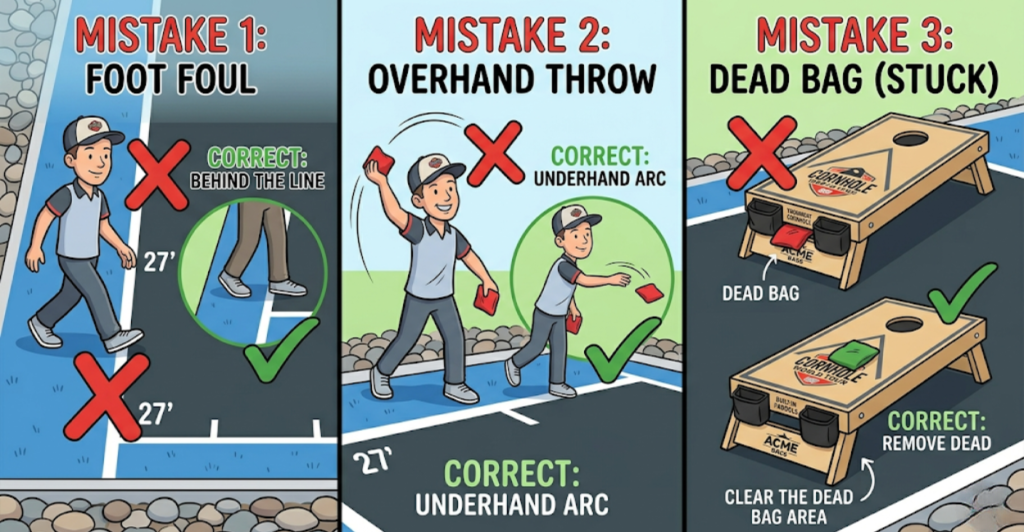
Mistake #1: Stepping Over the Line
Your feet must stay behind the front edge of the board.
Fix: Look down before every throw. Check your feet position. Step back if needed.
Mistake #2: Throwing Too Hard
Hard throws bounce off the board or fly over the back.
Fix: Aim for a soft landing. The bag should drop onto the board, not crash into it. Practice gentle tosses.
Mistake #3: Holding the Bag Wrong
Gripping the bag in your palm reduces control.
Fix: Pinch the bag between your thumb and fingers. The bag should rest against your fingertips, not your palm.
Mistake #4: Aiming at the Hole
The hole is not the target. The board in front of the hole is the target.
Fix: Aim for a spot 6‑12 inches in front of the hole. The bag will slide into the hole naturally.
Mistake #5: Throwing Overhand
Overhand throws are illegal in official cornhole. They also bounce unpredictably.
Fix: Keep your throws underhand. Swing your arm like a pendulum.
Mistake #6: Walking to Retrieve Bags After Every Throw
Retrieving bags after each throw wastes time and energy.
Fix: Throw all four bags before walking to the other side. Collect them all at once.
📷 IMAGE #6 PLACEMENT HERE
House Rules: When You Can Change Things
Official rules are guidelines. Backyard cornhole can be whatever you want.
Common House Rules
Closer boards for kids. Move boards to 15 or 20 feet. Young children can actually reach the board.
No cancellation scoring. Count every bag. This makes scoring easier for young kids.
Higher winning score. Play to 25 or 31 for longer games.
Lower winning score. Play to 11 or 15 for quick games.
The “bust” rule. Going over 21 drops you back to 13 or 15.
Dirty bags rule. Bags that hit dirt or grass before the board are dead. Some house rules allow them.
Drink in hand rule. Some casual games require holding a drink in your non‑throwing hand. Purely for fun.
Rules You Should Never Change
- Underhand throws only (safety and fairness)
- Feet behind the board edge (prevents advantage)
- Wait for your turn (no throwing at the same time)
Agree on house rules before starting. Arguments ruin good games.
Cornhole Lingo: Words You Will Hear
Learn these terms to sound like a pro.
| Term | Meaning |
|---|---|
| Woody | A bag on the board worth 1 point |
| Cornhole | A bag in the hole worth 3 points |
| Foul bag | A bag that does not count (ground contact, foot fault) |
| Dead bag | A bag that cannot be played (under the board, bounced off) |
| Air mail | A bag that goes directly into the hole without touching the board |
| Push shot | A throw that slides another bag into the hole |
| Block | A bag placed in front of the hole to block opponents |
| Clean sweep | All four bags in the hole in one round |
| Skunk | Winning a game before the opponent scores any points |
| Cancellation scoring | Only one team scores per round (the difference) |
| Pitcher’s box | The area where players must stand when throwing |
| Foul line | The line players cannot cross when throwing |
Frequently Asked Questions (FAQ)
Can children play cornhole?
Yes. Cornhole is great for kids. Move the boards closer (15‑20 feet). Use lighter bags if available. Skip cancellation scoring for very young children.
How long does a cornhole game take?
A standard game to 21 points takes 15‑25 minutes. Quick games to 11 take 10‑15 minutes. Tournament matches can run 30‑40 minutes.
Do I need official regulation boards?
No. Regulation boards are nice but not required. Backyard games work fine with any boards. The rules are the same regardless of board quality.
What happens if a bag falls off the board after landing?
Once a bag touches the board, it counts as a woody even if it later falls off. However, bags that roll off immediately (before stopping) usually do not count. Agree on this rule before playing.
Can a bag bounce off the ground onto the board?
No. Bags that touch the ground at any point are dead. They cannot score even if they bounce onto the board.
How many people can play cornhole?
Standard cornhole has 2 or 4 players (singles or doubles). With more players, rotate after each game. Some house rules allow 6 players rotating throws.
What is the official distance for kids?
No official distance exists. Most parents use 15 feet for young children (ages 5‑10). Teenagers can handle 20‑25 feet. Adults should use 27 feet.
Can I play cornhole alone?
Yes. Practice alone by throwing all eight bags and tracking your accuracy. Some practice apps help track progress.
Ready to Play? Your Next Steps
You now know everything a beginner needs.
Find a set of boards. Borrow from a friend or buy an inexpensive set. Many sporting goods stores sell cornhole sets for $50‑100.
Invite friends or family. Cornhole is more fun with others.
Set up in your backyard, a park, or even a driveway.
Play your first game. Do not worry about perfect technique. Just have fun.
After a few games, experiment with different throws. Try push shots. Learn to block.
But for now, just play.
Welcome to cornhole.
Sources & References
Official League Sources:
- American Cornhole Organization Official History – Official rules, scoring system, court dimensions
- American Cornhole League Official Homepage – League rules, beginner guides, tournament standards
Rules References:
- Cornhole America: ACO Official Rules – Complete rulebook, scoring explanations, foul definitions
- Special Olympics New Jersey: Cornhole Exhibition Rules – Simplified rules for beginners and adaptive play
Last updated: April 16, 2026
Author: TheaterOfSports Sports Desk