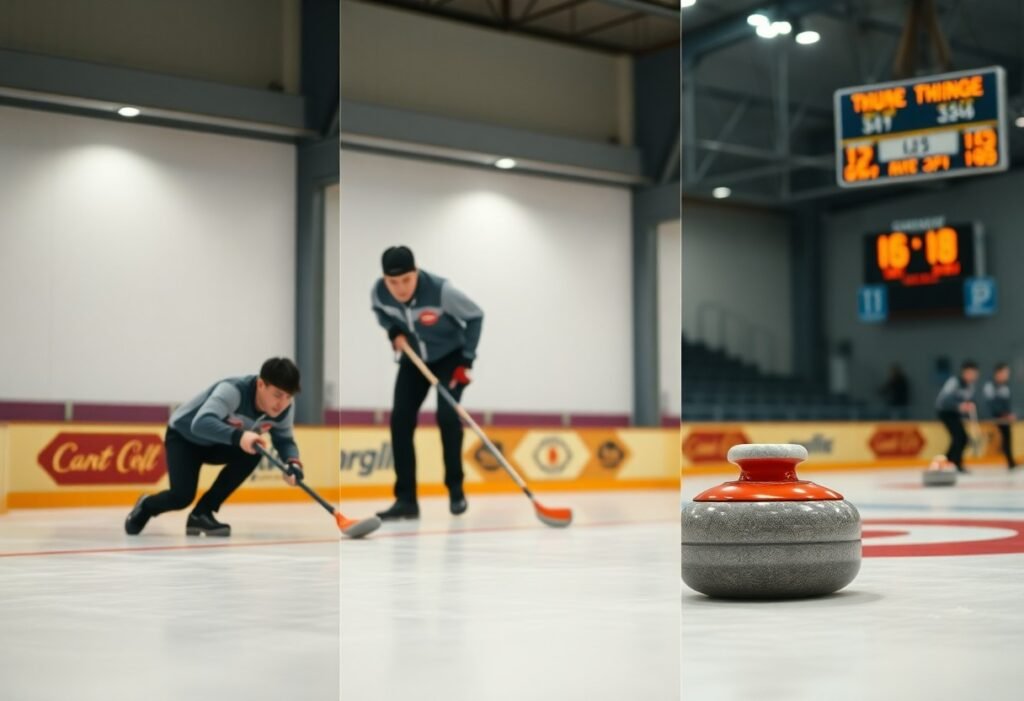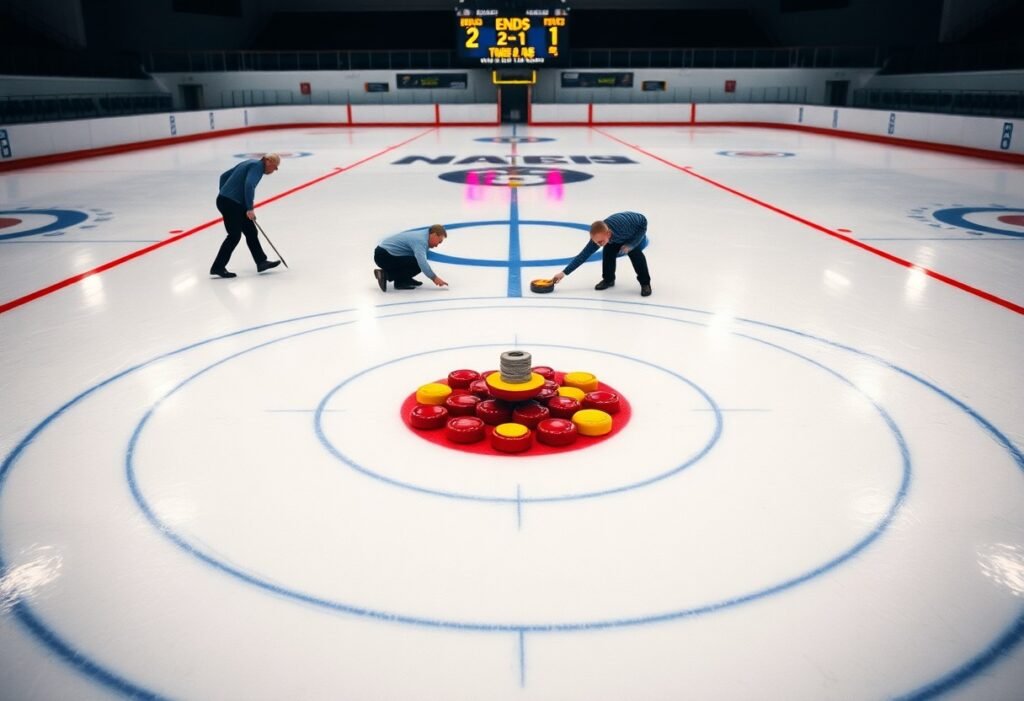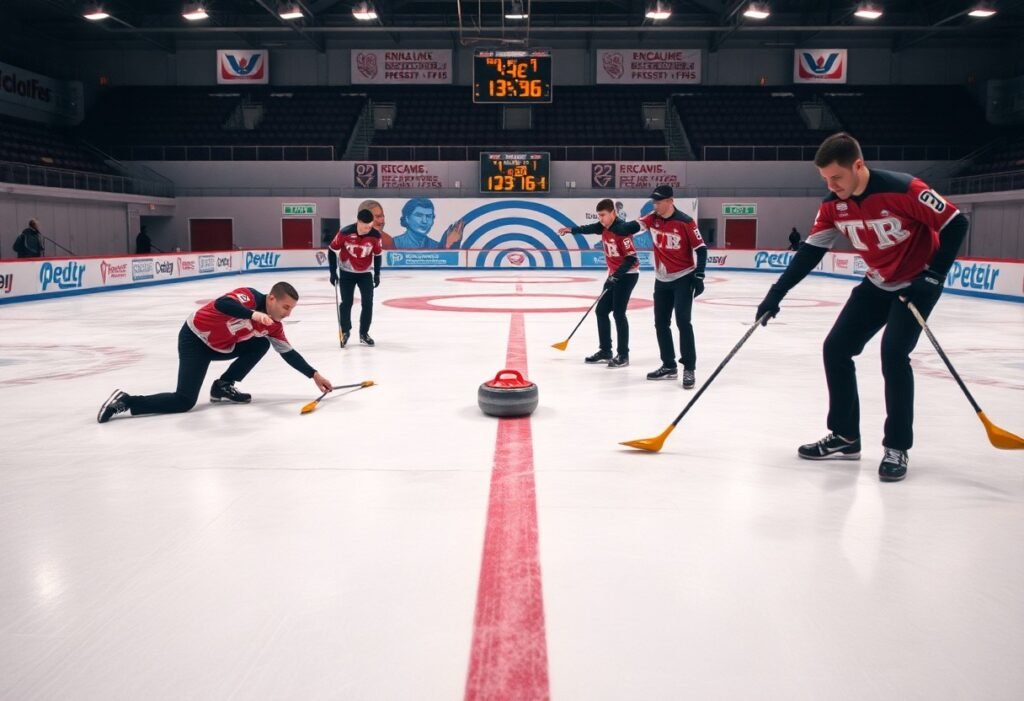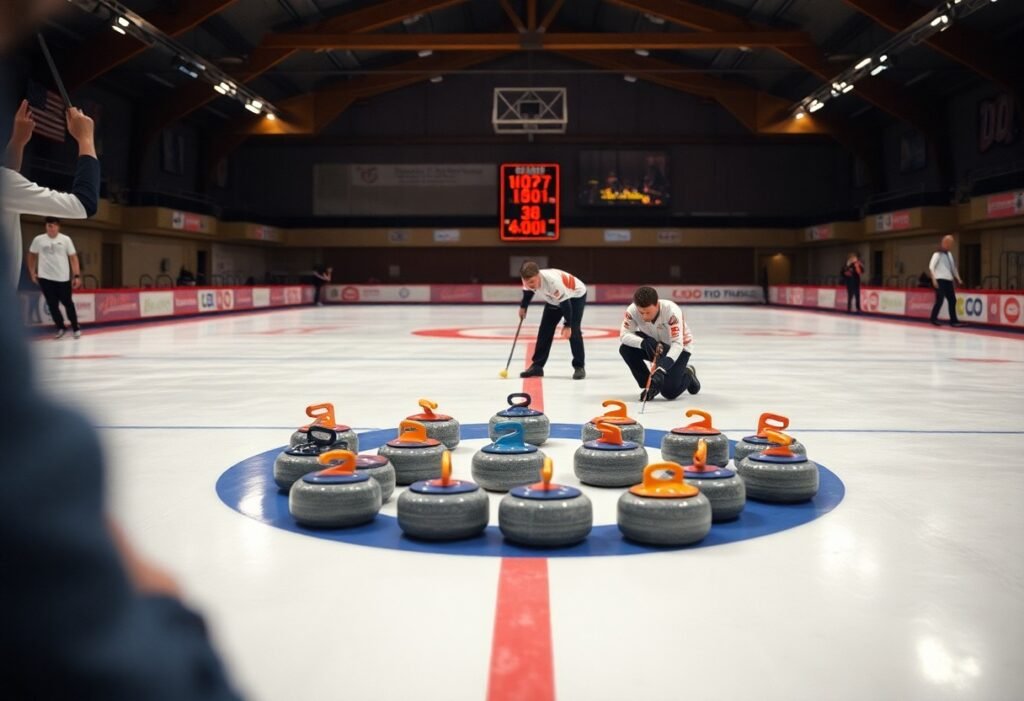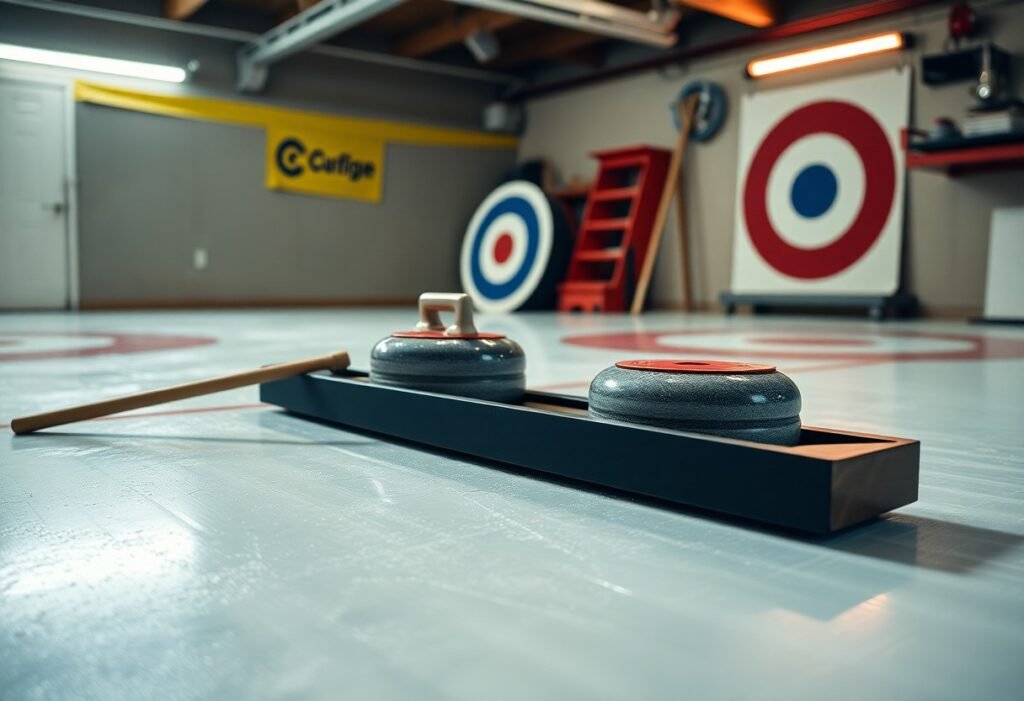

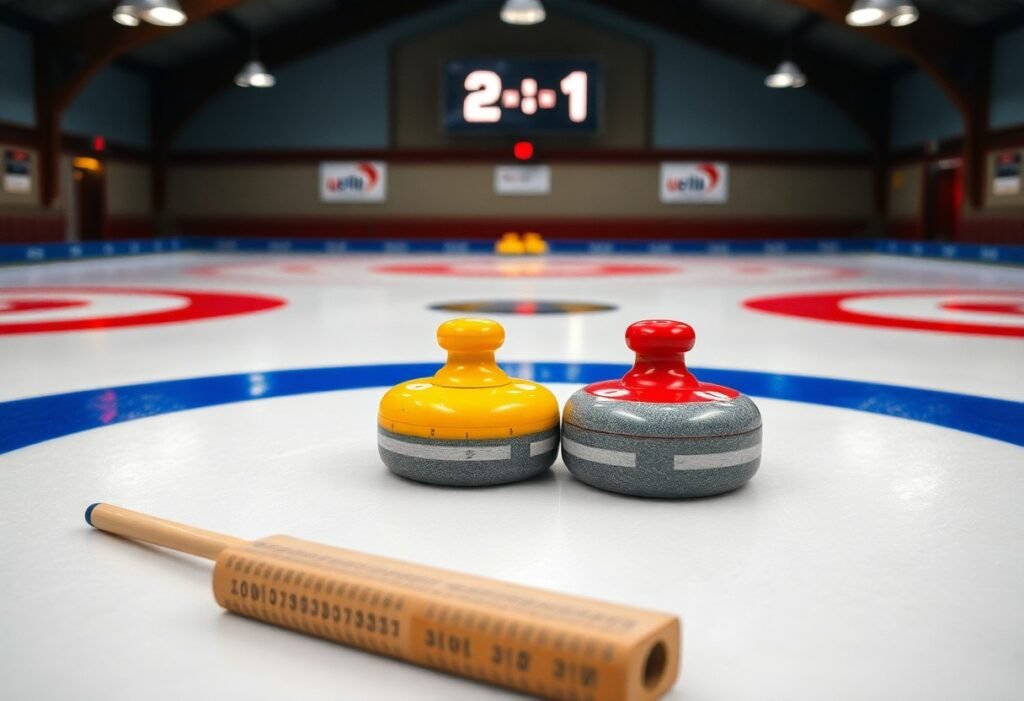
Many of you will find curling scoring simple once you learn how ends and stones determine points; after each end, only the team with the stone closest to the button scores, earning one point per stone closer than the opponent’s nearest, and the team with the hammer (last-stone advantage) has a strong strategic edge. You should also be aware that slippery ice and heavy stones can cause injury, so prioritize safety while focusing on placement and strategy to score multiple points.
Key Takeaways:
- Only one team scores per end: after all 16 stones are thrown, the team with the stone closest to the button scores one point for each of its stones that are closer than the opponent’s nearest stone.
- Only stones in the house (the concentric circles) can score; if the closest stones are equal distance or none are in the house, the end is blank (no score).
- The hammer (last-stone advantage) gives the best chance to score or force a blank; tied games go to extra ends until a winner is decided.
Basic Rules of Curling Scoring
Within each end you and the opposing team alternate throws, each side delivering 8 stones for 16 total; a standard match is 10 ends. After all stones are thrown the team with the rock closest to the button scores one point for every stone closer than the opponent’s nearest, so only one team scores per end. Teams frequently use blank ends to manage the hammer (last-stone advantage) and shape match strategy.
Objective of the Game
Your objective is to finish an end with as many of your stones inside the house and closer to the button than any opponent stones. Scoring awards one point per stone closer than the opponent’s nearest, so you can score up to a theoretical 8 points in an end, though 1-2 points are far more common; proximity to the button decides each point.
Overview of Gameplay
Stones travel down a 146-150 foot sheet toward concentric house circles (12‑, 8‑, 4‑foot diameters) while sweepers modify speed and curl with brooms to influence outcome. Each four-person team has players throw two stones per end, the skip calls shots, and you must release the rock before the near hog line or the stone is removed as a foul. The hammer often dictates offensive versus defensive choices.
Teams use tactics like blanking to keep the hammer, deliberately conceding an end to set up a later score, or attempting a steal when you score without last stone. Across a 10-end match you and your opponents each throw 80 stones, so precision on draw weight and takeouts matters; a single missed shot, a hog-line violation, or a burned stone can swing the result.

Scoring System
How Points Are Awarded
When an end finishes, you score only if your closest stone sits nearer to the button than any opponent stone; only one team scores per end. After all 16 stones are thrown (8 each), count every successive stone of yours that is closer than the opponent’s nearest – that total is your points for the end. For example, if you have the three closest stones, you score 3.
- End: 16 stones, 8 per team.
- Button: reference for distance.
- Counting: successive closer stones = points.
- Scoring team: only one team scores each end.
- Thou must count from the closest outward to total points.
| Situation | Points |
| One closest stone | 1 |
| Two closest stones | 2 |
| Three closest stones | 3 |
| No stones closer | 0 (opponent scores) |
Different Types of Points
You will see several curling scoring scenarios: a single-point end (common), a multi-point end (2+ points), a steal where the team without hammer scores, a blank end (0-0) to retain hammer, and a force when you limit the opponent to one. Steals of 1-2 points often decide tight games, while a 3+ end can swing momentum dramatically.
For concrete examples, in a provincial final you might steal 2 in the 9th to lead 7-5, then blank the 10th to keep hammer and win; that demonstrates how a steal plus strategic blanks control outcomes. Statistically, teams that average fewer than 1.5 steals per game still win by effective hammer use.
- Single-point: common, simple tally.
- Multi-point: 2+ stones closer; high reward.
- Steal: non-hammer team scores; game-changer.
- Blank end: 0-0 to retain hammer.
- Thou must recognize which type suits your strategy.
| Type | Example/Impact |
| Single-point | Opponent scores 1; minimal swing. |
| Multi-point | You score 2-4; big momentum shift. |
| Steal | You score while without hammer; strategic gain. |
| Blank end | No score; hammer retained for next end. |
Ends and Inning Structure
An end functions like an inning: each team throws eight stones, so an end uses 16 stones total. You alternate delivery and an end ends when all 16 stones are played or teams concede early. For rules and basic terms consult Cedar Rapids Curling Club – Curling Basics. Typical games have eight or ten ends; in competitive play you’ll often see ten.
Understanding Ends
During an end you manage stone placement, sweeping, and the hammer (last-stone advantage). If you hold the hammer you often play for multiple points; without it, you focus on forcing a single or blanking the end. For example, with the hammer you might draw to the button for 2-3 points, while without it you aim to remove opponent stones and limit them to one point.
Determining the Winner of an End
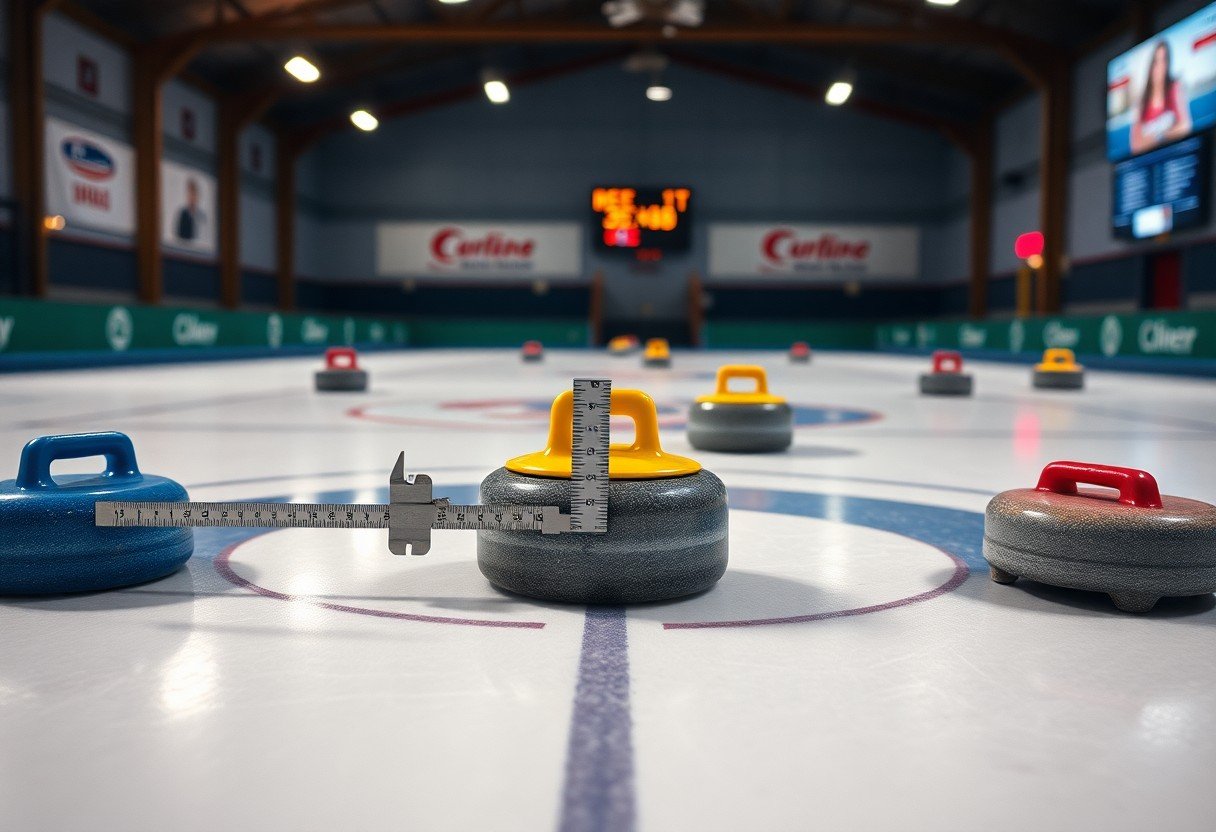
After stones stop, officials identify which stone is closest to the button; only the team with the closest stone scores. You score one point for each of your stones that is closer than the opponent’s nearest-so if three of your stones lie closer than the opponent’s nearest, you score three. Distances are measured when needed using a tape or specialized gauge.
Blank ends (no stones in the house) let you keep the hammer for the next end, which is a common tactical play. If measurements show an exact tie, officials use precise gauges and, if still tied, no points are awarded. For instance, blanking the third end in a ten-end game to retain hammer can change strategy for the final ends.

Tiebreakers and Extra Ends
Tournaments resolve tied standings either with ranking metrics or extra play; if you finish level in a round-robin, organizers often compare Draw Shot Challenge averages measured in centimeters or schedule one or more tiebreaker games. When a match itself finishes tied after regulation, teams go to extra ends played under normal end rules until a winner emerges, so tournament formats and timing determine whether you face another full game or a single deciding end.
When Tiebreakers are Needed in Curling Scoring
If you and other teams are tied for a playoff spot, tiebreakers decide seeding or qualification: common methods include head-to-head records, then the DSC average (each pre-game draw is measured and averaged in cm), and finally on-ice tiebreaker games. When three teams tie, organizers frequently give the best DSC a bye while the other two play one tiebreaker; winners then advance to the playoffs or additional tiebreaks.
Rules for Extra Ends
Extra ends follow the same stone allocation as regulation: in traditional team curling each side throws eight stones (16 total), while mixed doubles uses five stones per team. The hammer for the extra end is determined by the outcome of the last regulation end-the team that did not score in the previous end usually gets the hammer, and if the last end was blank the hammer carries over to the extra end.
Because extra ends are effectively sudden-death, strategy shifts: if you hold the hammer you often play conservatively to secure a single scoring stone, whereas without hammer you adopt aggressive tactics to force a steal. Competitions at high levels (Worlds, Olympics) will continue extra ends until a winner is decided, but some leagues use a single draw-to-the-button or shootout as a time-saving alternative.
Strategy and curling Scoring
You balance risk and reward each end by choosing when to score, blank, or force; with a 10-end game you often aim to convert the hammer into a two-point end early and preserve it when needed, while late ends push you to either protect a lead or chase a steal. Use guards and freezes to create scoring zones, and consider that a blank end often benefits the team holding hammer.
Strategic Importance of Scoring
When you hold the hammer, a deuce (2 points) changes momentum more than a single; without hammer, forcing an opponent to one is a win. Leading in the last three ends shifts you toward defensive play to limit swing shots, whereas trailing pushes you to generate multi-rock guards and aggressive draws. A well-timed steal can swing a game, so you prioritize shot selection to control the scoreboard.
Common Scoring Strategies
You use draws behind guards to build a house and takeouts to clear paths; typical choices include the center-guard setup for multiple scoring rocks, freezes to lock opponents out, and peel shots to remove guards when protecting a lead. Teams often attempt a double takeout to score two or more, while deliberately blanking an end preserves the hammer for a better opportunity.
For more detail, choose a draw-heavy plan when the ice favors curl and your skip reads weights well-this creates multiple curling scoring angles. Alternatively, if the opposition piles up guards, prioritize runbacks or double takeouts to reduce clutter; these shots are high-reward but carry higher miss risk, so execute them when you have the hammer or when the scoreboard forces aggression. In tied final ends, play tighter to avoid gifting a steal.
Common Misconceptions
You might hear that only one stone scores per end. That is false. You might also hear the hammer always wins. That is also false.
Each team throws eight stones per end. You can score up to eight points. This happens if all your stones are closer than any opponent’s.
The hammer only increases scoring opportunity. It does not guarantee points.
Clarifying Scoring Myths
Many players confuse the scoring rule. Only the closest stone does not count alone. You count every one of your stones in the house that is closer than the opponent’s nearest stone.
If two stones measure equal distance, the end can end with no score for either side.
Stones must be within the house to score. Touchers or stones fully outside the 12-foot circle do not contribute to your total.
Frequently Asked Questions
After all 16 stones are played or teams concede the end, officials measure and count points. The result is added to the match total immediately. A tied measurement yields no points that end. Scores accumulate across ends. A 2-1 lead after three ends means your team has two points overall while the opponent has one.
Most championship games use 10 ends. Many club games use 8 ends. This affects comeback strategies.
Trailing 4-1 after six ends in a 10-end game still leaves time. A big end, like scoring 4 points, can tie or take the lead. Plan shot selection around remaining ends. Consider whether you hold the hammer.
Conclusion
After each end, count your stones closer to the button than the opponent’s nearest stone. That total is your points for the end. Hammer control and blank ends shape strategy. Apply these basics to follow and evaluate any match.
FAQ
Q: How are points scored in a single end?
A: In each end both teams deliver eight stones alternately. After all 16 stones are played, only one team scores. The scoring team gets one point for every stone that is closer to the center of the house (the button) than the opponent’s nearest stone. For example, if three of Team A’s stones are closer to the button than Team B’s nearest stone, Team A scores three points for that end.
Q: What is an “end” and how many ends are in a game?
A: An end is one round of play where each team throws all eight stones. A standard game is usually eight or ten ends depending on the competition. Teams score after each end, and the team with the most total points at the end of all scheduled ends wins.
Q: What does “hammer” mean and how does it affect scoring?
A: The hammer is the advantage of throwing the last stone in an end. The team with the hammer can often score more or control whether they score at all. Teams sometimes intentionally blank (score zero) an end to keep the hammer for the next end and try to score multiple points later.
Q: What is a “steal” and how does it change the score?
A: A steal happens when the team without the hammer scores. The team with the hammer normally has the last-stone advantage. A steal is valuable for two reasons. It increases the stealing team’s total. It also denies the hammer team any points that end.
Q: Which basic terms help me understand the scoreline?
A: Key terms include: house (target rings), button (center of the house), guard (stone placed to block), draw (stone delivered to stop in the house), takeout (shot to remove an opponent’s stone), blank end (no scoring stones), and measure (tool used when stones are too close to call by eye). Knowing these terms helps you understand how many points were scored and why.